
Websites
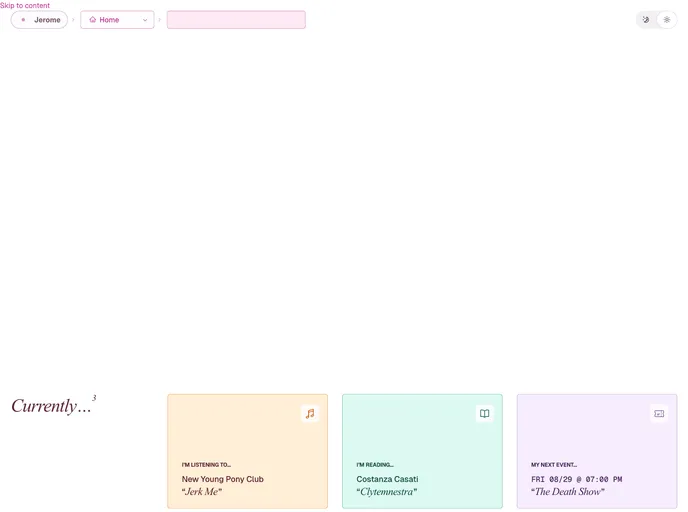


Jerome’s Website(s): Monorepo and somewhat over-engineered playground. (Next.js, Notion, Radix UI, Tailwind CSS, ...)
Overview
The project outlined appears to be a sophisticated and well-organized monorepo dedicated to streamlining development for various front-end solutions. It prominently leverages Next.js for its framework, along with an impressive assortment of tools and configurations tailored to create a seamless development experience. The documentation also highlights integration with Notion as a content management system, indicating a solid balance between usability and functionality.
Whether you’re a seasoned developer or someone keen on exploring modern web technologies, this setup promises to enhance productivity and accelerate project workflows through its robust design and deployment strategies.
Features
-
Comprehensive Monorepo Management: Utilizes pnpm workspaces and turborepo, facilitating an efficient structure for managing multiple packages and their dependencies.
-
Integration with Notion: Features a dedicated package for Notion as a CMS, which simplifies content management and enhances user experience in the development process.
-
Design System Implementation: Employs Radix UI for a consistent and reusable design system across applications, promoting uniformity and ease of design.
-
Optimized CI/CD with GitHub Actions: Automates deployment processes to Vercel through GitHub Actions, ensuring quick and reliable updates to live applications.
-
Advanced Release Management: Incorporates semantic versioning and automatic semantic release through conventional commits, helping maintain version control effortlessly.
-
Tailored Styling Solutions: Integrates Tailwind CSS for styling, which offers a utility-first approach to design, making styling components quick and adaptable.
-
Analytics Integration: Uses Fathom and Vercel for analytics, providing insights into user interactions while maintaining privacy and performance.
-
Patch and Minor Management Automation: Implements Renovate for automatic updates of package dependencies, keeping the project fresh and secure without manual intervention.
- Next.js
Next.js is a React-based web framework that enables server-side rendering, static site generation, and other powerful features for building modern web applications.
- React
React is a widely used JavaScript library for building user interfaces and single-page applications. It follows a component-based architecture and uses a virtual DOM to efficiently update and render UI components
- Tailwind
Tailwind CSS is a utility-first CSS framework that provides pre-defined classes for building responsive and customizable user interfaces.
- cmdk
cmdk is a fast, composable command menu component for React. It provides the foundation for building command palettes, search interfaces, and keyboard-navigable menus similar to those found in applications like VS Code, Linear, and Raycast.
- Radix UI
Radix Primitives is a low-level UI component library with a focus on accessibility, customization and developer experience. You can use these components either as the base layer of your design system, or adopt them incrementally.
- Notion
Notion is an all-in-one workspace that helps individuals and teams organize and manage their projects, notes, documents, and databases. It offers a range of features, including note-taking, task management, project planning, team collaboration, and more, all within a single app.
- Turborepo

Turbo is an incremental bundler and build system optimized for JavaScript and TypeScript, written in Rust.
- Typescript

TypeScript is a superset of JavaScript, providing optional static typing, classes, interfaces, and other features that help developers write more maintainable and scalable code. TypeScript's static typing system can catch errors at compile-time, making it easier to build and maintain large applications.