
Laravel Vue Datatable
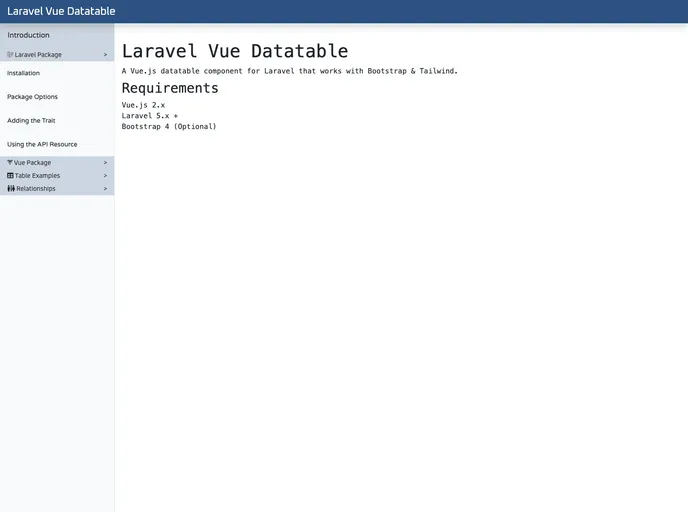





Vue.js Datatable made for Laravel
Overview
The Laravel Vue Datatable is an impressive Vue.js component perfectly tailored for Laravel applications. It seamlessly integrates with both Bootstrap and Tailwind, providing developers with flexibility in styling their data tables. Designed for ease of use, this component simplifies the process of handling tabular data, making it a valuable tool for anyone working within the Laravel ecosystem.
With support for essential features like pagination, sorting, and customizable columns, the Laravel Vue Datatable enables quick data retrieval while maintaining a smooth user experience. Whether you're creating a complex admin panel or a simple dashboard, this datatable component is equipped to handle diverse needs.
Features
- Compatibility: Works with Vue.js 2.x and Laravel 5.x, ensuring a smooth experience for modern web applications.
- Styling Options: Integrates with both Bootstrap 4 and Tailwind CSS, allowing for flexible design choices depending on your project requirements.
- Customizable Props: Offers a wide range of properties including URL, columns, and order settings, enabling developers to tailor the functionality to suit specific data handling needs.
- Debounce Delay: Includes a debounce delay for search requests, reducing unnecessary loads on the server during data retrieval.
- Dynamic Columns: Supports dynamic components for table columns, allowing for complex data structures and interactions like click events to be easily managed.
- Local Storage: Comes with an option to keep track of filters using local storage, improving usability for users interacting with the data table.
- Accessible Pagination: Provides customizable pagination buttons and search input placeholders, aiding accessibility and usability.
- Advanced Settings: Allows passing additional headers and custom classes for more complex integration scenarios, giving developers full control over their data tables.
- Laravel
Laravel is a powerful and elegant PHP framework that provides developers with a comprehensive set of tools and features to build robust web applications. It follows the Model-View-Controller (MVC) architectural pattern, offering a clean and organized structure for writing efficient and maintainable code.
- Vue
Vue.js is a lightweight and flexible JavaScript framework that allows developers to easily build dynamic and reactive user interfaces. Its intuitive syntax, modular architecture, and focus on performance make it a popular choice for modern web development.
- Bootstrap
Bootstrap is the most popular CSS Framework for developing responsive and mobile-first websites.
- SCSS
SCSS is a preprocessor scripting language that extends the capabilities of CSS by adding features such as variables, nesting, and mixins. It allows developers to write more efficient and maintainable CSS code, and helps to streamline the development process by reducing repetition and increasing reusability.
- Tailwind
Tailwind CSS is a utility-first CSS framework that provides pre-defined classes for building responsive and customizable user interfaces.
- Prism JS

PrismJS is an open-source, lightweight, and extensible syntax highlighting library that supports a wide range of programming languages and markup formats.
- Typescript

TypeScript is a superset of JavaScript, providing optional static typing, classes, interfaces, and other features that help developers write more maintainable and scalable code. TypeScript's static typing system can catch errors at compile-time, making it easier to build and maintain large applications.