
Datatracker
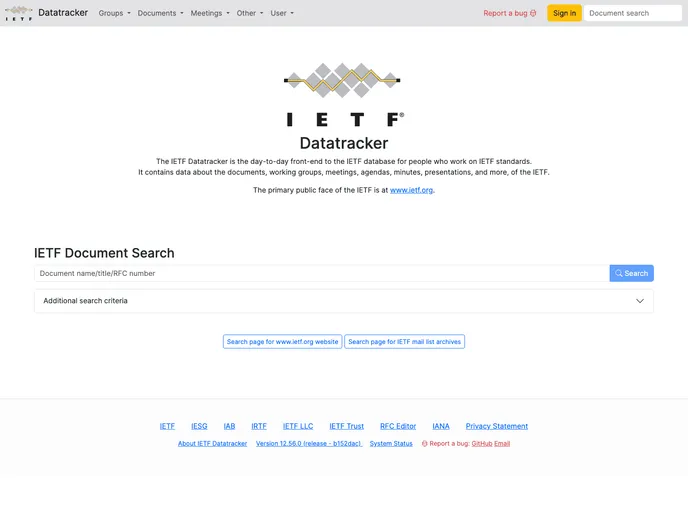




The day-to-day front-end to the IETF database for people who work on IETF standards.
Overview
The IETF Datatracker serves as a crucial tool for individuals involved in the development of IETF standards, streamlining the management and tracking of relevant data. This platform allows for efficient front-end interaction with a comprehensive database tailored to support the intricacies of standardization processes. Not only does it enhance productivity, but it also aims to foster collaboration and transparency within the IETF community.
Moreover, the development environment is built with modern tools, enabling a smooth and effective workflow for contributors. With clear guidelines and an easy-to-follow setup process, the Datatracker encourages participation from both new and seasoned developers looking to engage with IETF standards.
Features
- Docker Development Environment: Simplifies the setup process for developers, allowing quick deployment and testing with containers.
- Git Feature Workflow: Incorporates a standard development model, ensuring an organized and efficient approach to code contributions and management.
- Cloning Efficiency: Provides tips for limiting history depth when cloning projects, saving time and disk space during the initial setup.
- Support for Modern Tools: Integrates popular development tools like VS Code, facilitating ease of use and enhanced functionality with container management.
- Collaboration and Issue Tracking: Encourages community engagement through discussions for bug reports, enhancements, and feature requests, streamlining issue management.
- Comprehensive Documentation: Offers extensive guidance on everything from creating forks to deploying changes, ensuring developers have the necessary resources at their disposal.
- Continuous Testing: Promotes a testing workflow that verifies the development progress, ensuring all contributions are stable and functional before integration.
- Django
Django is a high-level Python web framework that encourages rapid development and clean, pragmatic design. It follows the model-view-controller (MVC) architectural pattern, providing an extensive set of built-in tools and conventions to streamline the creation of robust and scalable web applications.
- Vite
Vite is a build tool that aims to provide a faster and leaner development experience for modern web projects
- Vue
Vue.js is a lightweight and flexible JavaScript framework that allows developers to easily build dynamic and reactive user interfaces. Its intuitive syntax, modular architecture, and focus on performance make it a popular choice for modern web development.
- Bootstrap
Bootstrap is the most popular CSS Framework for developing responsive and mobile-first websites.
- SCSS
SCSS is a preprocessor scripting language that extends the capabilities of CSS by adding features such as variables, nesting, and mixins. It allows developers to write more efficient and maintainable CSS code, and helps to streamline the development process by reducing repetition and increasing reusability.
- Eslint

ESLint is a linter for JavaScript that analyzes code to detect and report on potential problems and errors, as well as enforce consistent code style and best practices, helping developers to write cleaner, more maintainable code.
- Pug
Pug is a high-performance template engine for Node.js and browsers that enables developers to write HTML templates using a concise and intuitive syntax. It supports a range of features, including template inheritance, conditionals, loops, mixins, and more, and can be easily integrated into a variety of web frameworks and build tools.
- Pinia

Pinia is the official state management library for Vue.js. It provides a simple and intuitive API with full TypeScript support, devtools integration, and modular design. Pinia replaces Vuex as the recommended state management solution for Vue 3.