
Svelte Virtual List
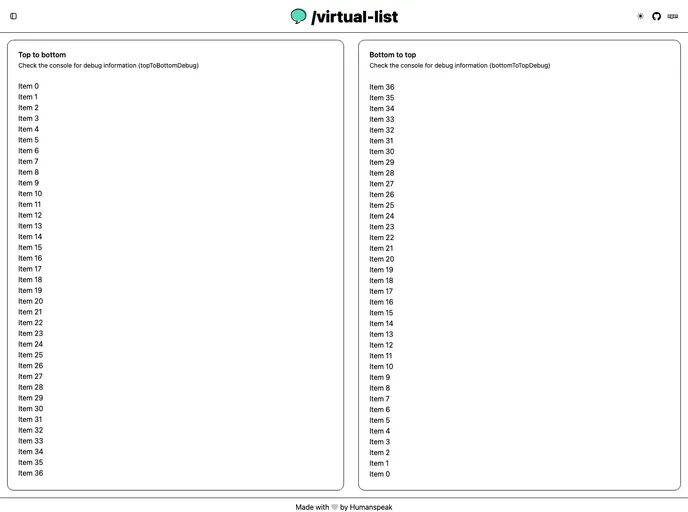



A performant virtual list/scrolling component for Svelte applications - efficiently render large scrollable lists with minimal memory usage
Overview
The @humanspeak/svelte-virtual-list is an essential tool for developers working with Svelte 5 applications, particularly when handling large datasets. This high-performance virtual list component stands out due to its efficient memory usage and impressive capabilities, allowing for smooth scrolling and dynamic content management. It's perfect for applications requiring fast rendering, such as chat applications or extensive data displays.
What truly sets this virtual list apart is its adaptability to various use cases. With features focused on user experience and performance, it ensures that even dense datasets remain manageable without sacrificing fluidity. Its TypeScript support guarantees clear and type-safe code, making it an attractive option for modern web development.
Features
- Dynamic item height handling: No need for fixed heights, accommodating a variety of item sizes for better flexibility.
- Bi-directional scrolling support: Allows scrolling from top-to-bottom or bottom-to-top, ideal for chat-like interfaces.
- Automatic resize handling: Adjusts to dynamic content seamlessly, maintaining efficiency.
- TypeScript support: Benefits from full type safety, enhancing code clarity and robustness.
- SSR compatible: Offers support for server-side rendering with hydration, optimizing performance for large applications.
- Customizable styling: Easily personalize the appearance using class props to fit your app's design.
- Debug mode: Provides a dedicated mode for development purposes, making troubleshooting simpler.
- Smooth scrolling: Configurable buffer zones ensure a pleasant scroll experience, even with extensive data lists.
- Svelte
Svelte is a modern front-end framework that compiles your code at build time, resulting in smaller and faster applications. It uses a reactive approach to update the DOM, allowing for high performance and a smoother user experience.
- Vite
Vite is a build tool that aims to provide a faster and leaner development experience for modern web projects
- Tailwind
Tailwind CSS is a utility-first CSS framework that provides pre-defined classes for building responsive and customizable user interfaces.
- UI Kits & Components

A UI kit provides developers with a set of reusable components that can be easily integrated into a website or application. These components are pre-designed with consistent styling and functionality, allowing developers to save time and effort in the design and development process. UI kits can be either custom-built or third-party, and often include components for buttons, forms, typography, icons, and more.
- Eslint

ESLint is a linter for JavaScript that analyzes code to detect and report on potential problems and errors, as well as enforce consistent code style and best practices, helping developers to write cleaner, more maintainable code.
- Typescript

TypeScript is a superset of JavaScript, providing optional static typing, classes, interfaces, and other features that help developers write more maintainable and scalable code. TypeScript's static typing system can catch errors at compile-time, making it easier to build and maintain large applications.
- Web Components

Web components provide a way to create reusable, encapsulated UI components using standard web technologies such as HTML, CSS, and JavaScript. They allow developers to create complex UI components that can be easily shared across multiple projects and frameworks. Web components are built using four main specifications: Custom Elements, Shadow DOM, HTML Templates, and ES Modules.