
Svelte Markdown
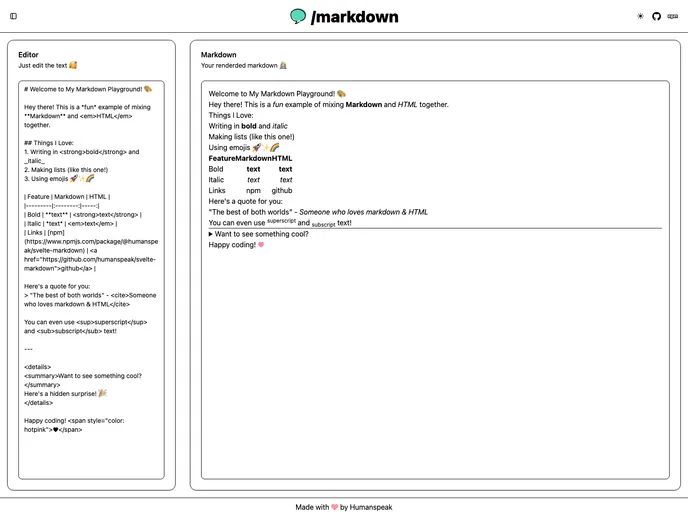


Fast, lightweight Markdown renderer component for Svelte applications with full CommonMark support
Overview
The @humanspeak/svelte-markdown package presents a powerful and customizable solution for rendering markdown within Svelte applications. Built as an advanced successor to the original svelte-markdown, this version has been enhanced by Humanspeak, Inc., providing seamless TypeScript support along with a robust feature set that caters to both developers and users alike. With an emphasis on performance, security, and flexibility, this renderer sets a new standard for working with markdown in Svelte.
The package boasts significant performance improvements, including intelligent token caching that enhances re-render speeds dramatically. This feature, combined with built-in lazy loading for images and comprehensive support for markdown syntax, positions @humanspeak/svelte-markdown as a foundational tool for modern web development.
Features
- Intelligent Token Caching: Achieves 50-200x faster re-renders using an automatic LRU cache, ensuring minimal latency for cached content.
- Smart Image Lazy Loading: Automatically loads images with smooth fade-in animations while managing errors, resulting in a 70% bandwidth reduction for image-heavy documents.
- Full Markdown Syntax Support: Employs Marked for comprehensive markdown syntax rendering, ensuring compatibility with a wide range of markdown features.
- Complete TypeScript Support: Utilizes strict typing, enhancing code quality and providing better developer experience through TypeScript.
- Customizable Component Rendering: Allows developers to customize how markdown components are rendered for greater design flexibility.
- Secure HTML Parsing: Implements HTMLParser2 for secure parsing, protecting against common web vulnerabilities.
- Accessibility Compliance: Meets WCAG 2.1 standards, ensuring that rendered content is accessible to all users.
- Enhanced Token Cleanup: Improves handling of nested content and attributes, providing better structure and readability in the output.
- Svelte
Svelte is a modern front-end framework that compiles your code at build time, resulting in smaller and faster applications. It uses a reactive approach to update the DOM, allowing for high performance and a smoother user experience.
- Vite
Vite is a build tool that aims to provide a faster and leaner development experience for modern web projects
- Documentation

Documentation themes are built specifically for writing technical and product documentation. They are normally written and maintained in Markdown. The often include a navigation menu, search bar, clear headings, semantic document structure and clean typography.
- UI Kits & Components

A UI kit provides developers with a set of reusable components that can be easily integrated into a website or application. These components are pre-designed with consistent styling and functionality, allowing developers to save time and effort in the design and development process. UI kits can be either custom-built or third-party, and often include components for buttons, forms, typography, icons, and more.
- Eslint

ESLint is a linter for JavaScript that analyzes code to detect and report on potential problems and errors, as well as enforce consistent code style and best practices, helping developers to write cleaner, more maintainable code.
- Typescript

TypeScript is a superset of JavaScript, providing optional static typing, classes, interfaces, and other features that help developers write more maintainable and scalable code. TypeScript's static typing system can catch errors at compile-time, making it easier to build and maintain large applications.
- Web Components

Web components provide a way to create reusable, encapsulated UI components using standard web technologies such as HTML, CSS, and JavaScript. They allow developers to create complex UI components that can be easily shared across multiple projects and frameworks. Web components are built using four main specifications: Custom Elements, Shadow DOM, HTML Templates, and ES Modules.