
Shopify Next.js Tailwind
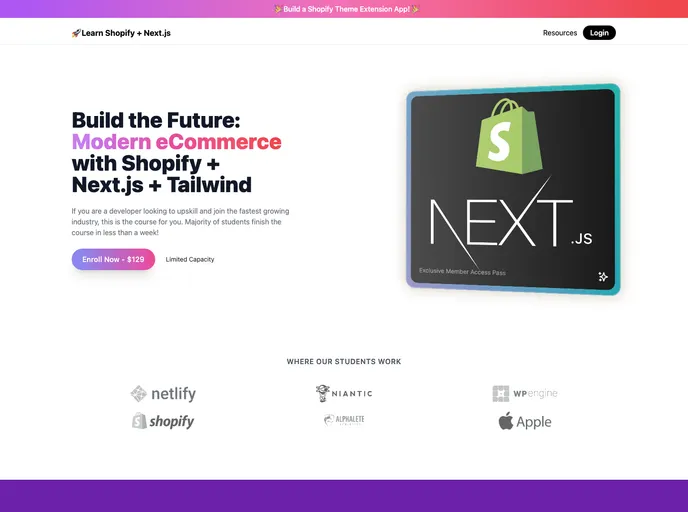





Learn the Shopify + Next.js + Tailwind CSS Stack! SWR, Hydrogen, + more
Overview
The Shopify + Next.js + Tailwind CSS course offers a production-ready Headless Shopify storefront using Next.js, Shopify Storefront API (GraphQL), Tailwind CSS, and Vercel. The course is designed to teach developers how to create blazing fast storefronts for eCommerce, manage cart data with React Context and localStorage, and rapidly develop components with Tailwind CSS. The course also covers topics such as GraphQL query testing, Shopify Partners Account and Dashboard, and Vercel for deployment. Future updates will include webhooks triggering for product updates and additional eCommerce-ready sections for Next.js using Tailwind CSS.
Features
- Blazing fast storefronts using Next.js for eCommerce.
- Managing Cart data with React Context and localStorage.
- Rapid component development with Tailwind CSS.
- GraphQL query testing using the GraphiQL app.
- Shopify Partners Account and Dashboard.
- Shopify Storefront API (GraphQL).
- Vercel for deployment.
- Performance optimization.
Summary
The Shopify + Next.js + Tailwind CSS course provides developers with the knowledge and tools to create a production-ready Headless Shopify storefront. With a focus on speed and performance, the course covers essential features such as eCommerce storefront development with Next.js, cart management with React Context, rapid component development with Tailwind CSS, and GraphQL query testing. The course also includes instructions on setting up a Shopify Partners Account and Dashboard, utilizing the Shopify Storefront API (GraphQL), and deploying the storefront using Vercel. With future updates in the pipeline, the course continues to evolve, offering additional features and enhancements for eCommerce development.
- Next.js
Next.js is a React-based web framework that enables server-side rendering, static site generation, and other powerful features for building modern web applications.
- React
React is a widely used JavaScript library for building user interfaces and single-page applications. It follows a component-based architecture and uses a virtual DOM to efficiently update and render UI components
- SCSS
SCSS is a preprocessor scripting language that extends the capabilities of CSS by adding features such as variables, nesting, and mixins. It allows developers to write more efficient and maintainable CSS code, and helps to streamline the development process by reducing repetition and increasing reusability.
- Tailwind
Tailwind CSS is a utility-first CSS framework that provides pre-defined classes for building responsive and customizable user interfaces.
- Headless UI
Headless UI is a set of completely unstyled, fully accessible UI components for React, Vue, and Alpine.js that empower developers to build their own fully accessible custom UI components. Headless UI allows developers to focus on building accessible and highly functional user interfaces, without the need to worry about styling or layout.
- Shopify
Shopify offers headless commerce capabilities through its Storefront API, allowing developers to use their own front-end technology to create custom storefronts or sales channels while using Shopify as a back-end system
- Ecommerce

Ecommerce websites sell products or services to customers through an online storefront. These websites typically include features such as product listings, shopping carts, payment processing, and order management tools.
- Postcss

PostCSS is a popular open-source tool that enables web developers to transform CSS styles with JavaScript plugins. It allows for efficient processing of CSS styles, from applying vendor prefixes to improving browser compatibility, ultimately resulting in cleaner, faster, and more maintainable code.