
HelloDjango Blog Tutorial
免费带你学 django 全栈!基于 django 2.2 的个人博客,初学者绝对不能错过的 django 教程!。◕ᴗ◕。
Overview:
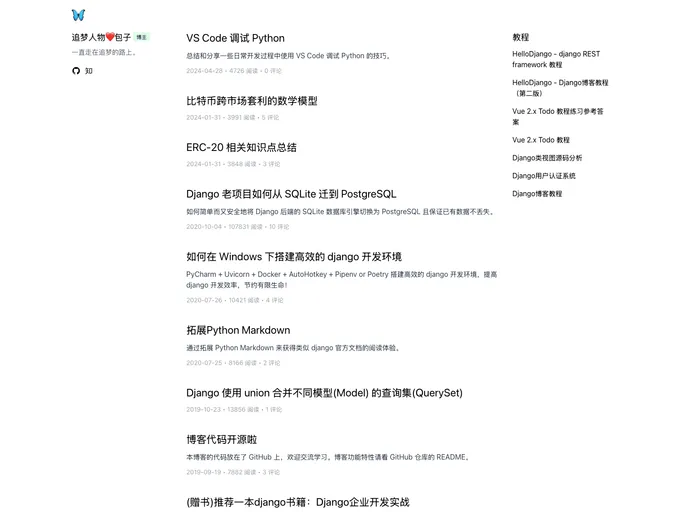
This project aims to develop a fully functional, thoroughly tested, and production-ready open-source blog system. Unlike other open-source blog systems, this project extensively documents the development process from 0 to 1 in the form of tutorials. The master branch is the main branch of the project, with each key development corresponding to a detailed tutorial and specific commit history. The resources include live previews, tutorials on HelloGitHub WeChat public account and Dreamer's blog, and the online learning address for the HelloDjango Django Blog Tutorial (Second Edition) project.
Features:
- Detailed documentation of the development process from 0 to 1 in the form of tutorials
- Multiple methods for local deployment including Virtualenv, Pipenv, and Docker
- Full-text search functionality utilizing Elasticsearch service
- Easy installation process with simple command executions
- Capability to create and manage backend administrators
Virtualenv:
- Clone the repository locally.
- Create a virtual environment and activate it.
- Install project dependencies.
- Migrate the database.
- Create a backend admin account.
- Run the development server.
- Access the admin backend at http://127.0.0.1:8000/admin to publish articles.
- Visit http://127.0.0.1:8000 to access the blog homepage.
Pipenv:
- Install Pipenv if not already installed.
- Install project dependencies.
- Migrate the database.
- Create a backend admin account.
- Run the development server.
- Access the admin backend at http://127.0.0.1:8000/admin to publish articles.
- Visit http://127.0.0.1:8000/ to access the blog homepage.
Docker:
- Install Docker and Docker Compose.
- Build and start containers.
- Create a backend admin account.
- Access the admin backend at http://127.0.0.1:8000/admin to publish articles.
- Visit http://127.0.0.1:8000/ to access the blog homepage.
Online Deployment:
- Clone the code to the server.
- Create an environment variable file to store sensitive project information.
- Modify Nginx configuration.
- Start the containers.
- Configure HTTPS certificate.
- Access the blog homepage using the domain name or server IP.
Summary:
This open-source blog project provides detailed tutorials documenting the development process from scratch. It offers simple installation processes using Virtualenv, Pipenv, or Docker, and includes features such as full-text search with Elasticsearch. Local deployment and online deployment are explained with step-by-step instructions to set up and manage the blog system efficiently.