
Headless Try
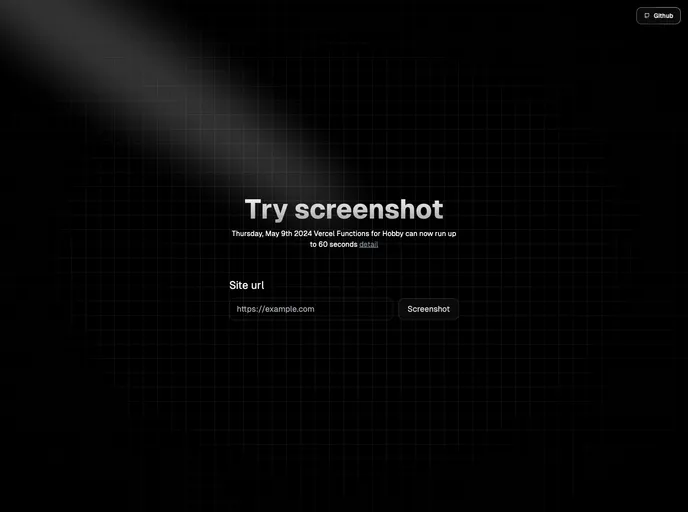


Nextjs use headless deploy with vercel.com
Overview
The product appears to be a development tool that allows users to capture webpage screenshots efficiently. It leverages the capabilities of a headless browser deployed on Vercel, making it a robust solution for web developers and testers. With its integration of features like Cloudflare support and the ability to run locally, this tool streamlines the process of generating screenshots from websites, catering to various needs in web development.
Features
-
Webpage Screenshots: Easily capture high-quality screenshots of any webpage, simplifying the testing and documentation process.
-
Local Development: Start a development server and view results live in your browser, making it convenient to check changes in real-time.
-
Cloudflare Support: Bypass Cloudflare’s protection mechanisms with the built-in "nopecha" functionality for smoother operations.
-
Headless Browser Integration: Utilizes a headless browser for fast, automated processing of webpage rendering and screenshot generation.
-
Vercel Deployment: Seamlessly deploy your application on Vercel for a robust, scalable solution that requires minimal setup.
-
User-Friendly Interface: The tool offers an intuitive experience, making it accessible even for those with limited technical backgrounds.
- Next.js
Next.js is a React-based web framework that enables server-side rendering, static site generation, and other powerful features for building modern web applications.
- React
React is a widely used JavaScript library for building user interfaces and single-page applications. It follows a component-based architecture and uses a virtual DOM to efficiently update and render UI components
- Tailwind
Tailwind CSS is a utility-first CSS framework that provides pre-defined classes for building responsive and customizable user interfaces.
- Geist UI
Geist UI is a modern, minimalist React component library inspired by Vercel's design language. It provides clean, elegant components with a focus on simplicity and developer experience, perfect for building modern web applications.
- Eslint

ESLint is a linter for JavaScript that analyzes code to detect and report on potential problems and errors, as well as enforce consistent code style and best practices, helping developers to write cleaner, more maintainable code.
- Framer Motion

Alpine.js is a lightweight JavaScript framework that simplifies the process of creating dynamic, reactive user interfaces on the web. It uses a declarative syntax that offers a higher level of abstraction compared to vanilla JavaScript, while being more performant and easier to use than jQuery.
- Postcss

PostCSS is a popular open-source tool that enables web developers to transform CSS styles with JavaScript plugins. It allows for efficient processing of CSS styles, from applying vendor prefixes to improving browser compatibility, ultimately resulting in cleaner, faster, and more maintainable code.
- Vercel

Vercel offers built-in support for deploying and hosting Next.js applications, making it a popular choice among Next.js developers.