
React Cheatsheet
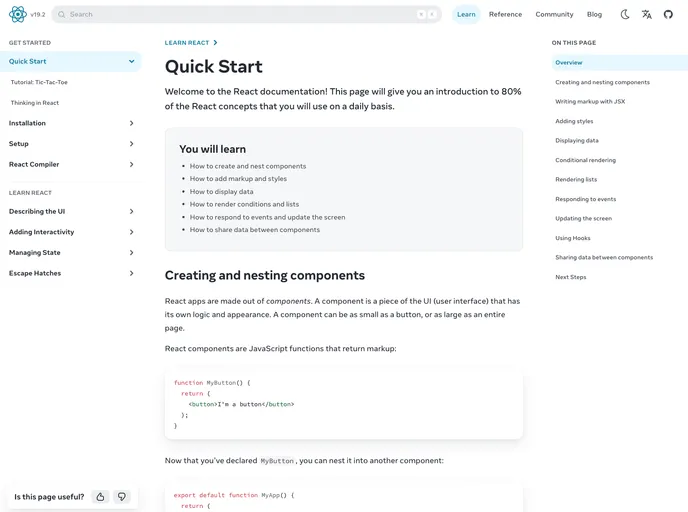

A React cheat sheet is a concise reference guide for developers who are working with React, a popular JavaScript library for building user interfaces. ,React components and lifecycle methods,Debugging and error handling,Hooks and functional components,Managing state and props,Handling error etc
Overview
JSX, short for JavaScript XML, is a powerful syntax extension that allows developers to write HTML directly within JavaScript code, particularly in React applications. This capability simplifies the creation of dynamic and interactive user interfaces, combining the simplicity of HTML with the full potential of JavaScript. Understanding JSX, along with the concepts of props and state in React, is essential for building modern web applications.
The transition from traditional component state management to hooks has revolutionized the way developers handle component logic. The flexibility offered by hooks makes it easier to create and manage component states, as well as respond to user interactions. By exploring basic concepts like state increments, asynchronous updates, and local storage integration, developers can enhance user experiences while maintaining clean and testable code.
Features
- JSX Syntax: Enables writing HTML-like code directly in JavaScript, making UI creation straightforward and intuitive.
- Props Functionality: Props are read-only components that allow for passing data and attributes into React components, similar to HTML attributes.
- Component State Management: Each component can create and manage its own internal data, allowing for rich interactivity and dynamic rendering.
- Event Handling: Simplifies the process of binding methods for events such as incrementing or resetting component states.
- Asynchronous State Updates: Incorporates functions as arguments in
this.setState, providing improved flexibility and responsiveness in state changes. - Callbacks Support: Offers an additional argument in
this.setStateto execute actions after state updates, facilitating side effects like logging or state persistence. - LocalStorage Integration: Provides strategies for updating local storage in response to state changes, enhancing data retention across sessions.
- Destructuring Capability: Allows for cleaner code and improved readability by destructuring props and states within components.
- React
React is a widely used JavaScript library for building user interfaces and single-page applications. It follows a component-based architecture and uses a virtual DOM to efficiently update and render UI components