
Handcash Connect Nextjs Example
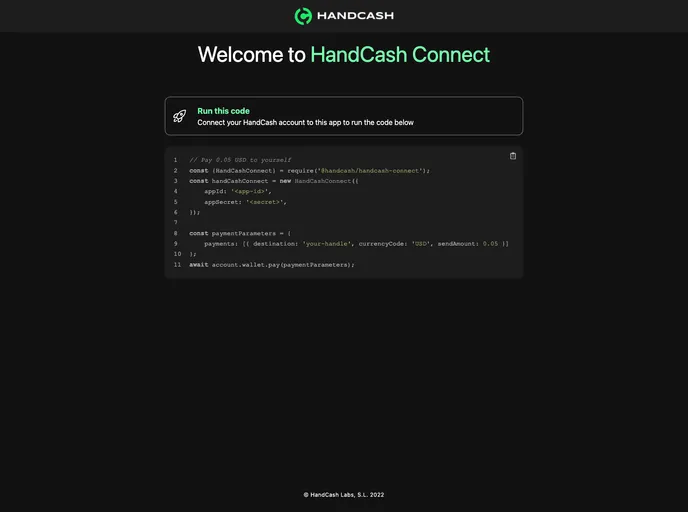


Getting started with HandCash Connect + NextJs
Overview
HandCash Connect is an external service that developers can use for authentication and payment processing. It provides an authentication flow where users are redirected from the app to HandCash and then redirected back to the app with an authToken and sessionToken. The authToken is stored on the server and a new sessionToken is generated based on JWT. Developers have the flexibility to implement their own authentication system while using HandCash as the basis for authentication. Additionally, HandCash Connect allows developers to trigger payments through an internal API endpoint.
Features
- Authentication flow: Users are redirected to HandCash for authentication and redirected back to the app with an authToken and sessionToken.
- Exposing authToken as little as possible: The authToken is stored on the server and a new sessionToken is generated based on JWT.
- Flexibility in authentication system: Developers can implement their own authentication system and use HandCash as an external service.
- Triggering payments: The app can initiate payments by calling an internal API endpoint and sending the sessionToken as a Bearer token.
Summary
HandCash Connect is a service that provides authentication and payment processing for developers. It offers an authentication flow where users are redirected to HandCash for authentication and redirected back to the app with an authToken and sessionToken. The authToken is stored on the server and a new sessionToken is generated based on JWT. This approach allows developers to implement their own authentication system while using HandCash as an external service. HandCash Connect also provides functionality to trigger payments through an internal API endpoint.
- Next.js
Next.js is a React-based web framework that enables server-side rendering, static site generation, and other powerful features for building modern web applications.
- React
React is a widely used JavaScript library for building user interfaces and single-page applications. It follows a component-based architecture and uses a virtual DOM to efficiently update and render UI components
- Tailwind
Tailwind CSS is a utility-first CSS framework that provides pre-defined classes for building responsive and customizable user interfaces.
- Eslint

ESLint is a linter for JavaScript that analyzes code to detect and report on potential problems and errors, as well as enforce consistent code style and best practices, helping developers to write cleaner, more maintainable code.
- Postcss

PostCSS is a popular open-source tool that enables web developers to transform CSS styles with JavaScript plugins. It allows for efficient processing of CSS styles, from applying vendor prefixes to improving browser compatibility, ultimately resulting in cleaner, faster, and more maintainable code.