
Remixing
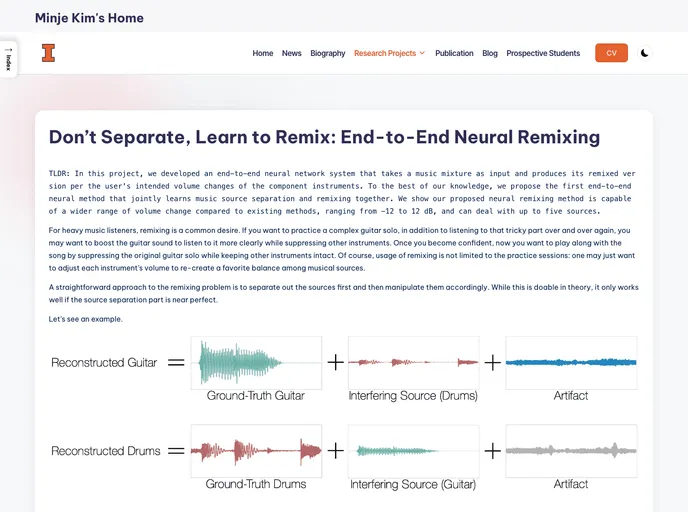
Official repo of ICASSP 2022 paper - Don't Separate, Learn to Remix: End-to-End Neural Remixing with Joint Optimization
Overview
The concept of neural remixing has taken significant strides, and the paper "Don't Separate, Learn to Remix: End-to-End Neural Remixing with Joint Optimization" presents an innovative approach that promises to revolutionize how we process audio. By employing a joint optimization strategy, this framework integrates various sources of audio in a way that enhances both clarity and manipulative capabilities. The authors, including H. Yang and M. Kim, underlined the potential of their method at the ICASSP 2022 conference, highlighting how it could set new standards in audio processing and remixing.
The accompanying open-source code facilitates straightforward implementation and provides excellent accessibility for those looking to experiment with neural remixing technologies. It effectively serves both researchers and enthusiasts alike, allowing them to engage directly with the latest advancements in audio technology.
Features
-
Open-Source Code: Allows easy access to the full implementation of the neural remixing framework, promoting collaboration and innovation.
-
Joint Optimization: Combines multiple audio sources into a cohesive mix while optimizing for sound quality, reducing the traditional separation methods' limitations.
-
Varied Dataset Support: Works seamlessly with MUSDB18 and Slakh datasets, enabling flexible testing across different audio sources.
-
Flexible Training: Customizable parameters like number of sources and loss weights ensure that users can optimize training based on their specific needs.
-
Evaluation Tools: Includes scripts to evaluate model performance on specific tracks, making it easier to assess results and make adjustments.
-
Python Compatibility: Built to run in Python 3.6.0 and integrates with popular packages like PyTorch, ensuring it fits within common data science workflows.
-
Comprehensive Documentation: Detailed instructions on data processing, training, and evaluation steps help users navigate the complexities of audio remixing.
-
Advanced Model Features: Options for settings like silent data inclusion and ratio on representation metrics provide advanced users with greater control over model training outcomes.