
EHTML
HTML as Template Language
Overview
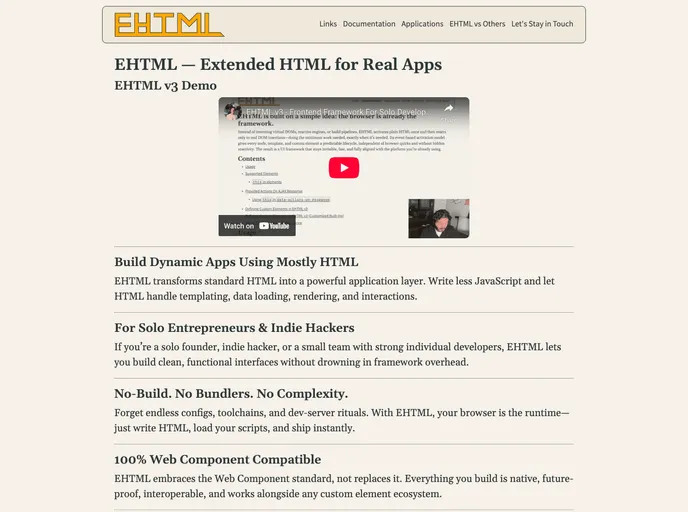
v1.0.153EHTML CIEHTML (or Extended HTML) is a library that allows users to easily incorporate custom elements into their HTML pages for various purposes. The main objective of this library is to minimize the need for JavaScript code on the client side, especially for basic and repetitive tasks. EHTML primarily focuses on simplifying AJAX operations by utilizing HTML, and it treats HTML code not only as a markup language but also as a templating language.
Features
- Custom Elements: Users can add custom elements to their HTML pages for specific functionalities and use cases.
- AJAX Operations: EHTML provides a straightforward way to perform AJAX operations using HTML syntax.
- HTML Templating: EHTML treats HTML code as both a markup language and a templating language, allowing for more versatile use cases.
Summary
v1.0.153EHTML CIEHTML is a library that enhances HTML by introducing custom elements and simplifying tasks that would otherwise require JavaScript. Its focus on AJAX operations and HTML templating makes it a convenient tool for both basic and advanced use cases. The ease of installation and integration makes EHTML a valuable asset for developers looking to streamline their client-side code.
- Eslint

ESLint is a linter for JavaScript that analyzes code to detect and report on potential problems and errors, as well as enforce consistent code style and best practices, helping developers to write cleaner, more maintainable code.
- Web Components

Web components provide a way to create reusable, encapsulated UI components using standard web technologies such as HTML, CSS, and JavaScript. They allow developers to create complex UI components that can be easily shared across multiple projects and frameworks. Web components are built using four main specifications: Custom Elements, Shadow DOM, HTML Templates, and ES Modules.