
Ng Dynamic Component
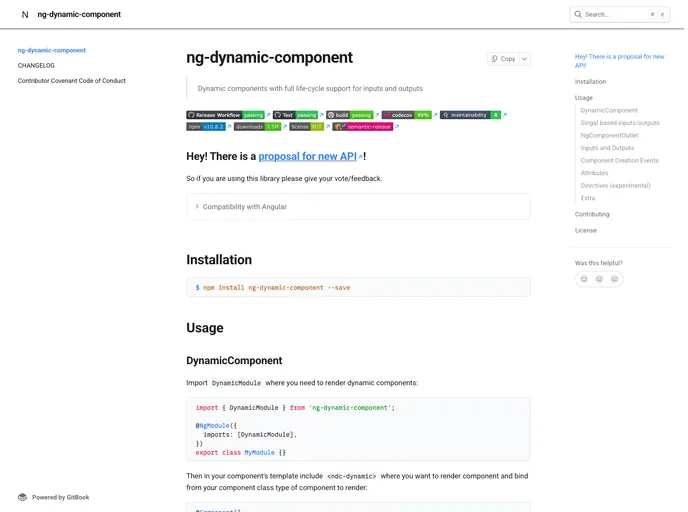

Dynamic components with full life-cycle support for inputs and outputs for Angular
Overview
The ng-dynamic-component is a powerful Angular library designed for developers looking to create dynamic components with full life-cycle support. With the increasing demand for flexible and modular applications, this package simplifies the process of rendering components dynamically, allowing for efficient and effective management of inputs and outputs. Whether you are building a complex application or just need a quick solution for dynamic UI components, ng-dynamic-component provides a comprehensive set of features that can enhance your development experience.
This library supports multiple versions of Angular, ensuring that developers can utilize it across various projects. Its installation and usage are straightforward, requiring minimal setup to render dynamic components in your Angular application. With the recent updates, it has become even more versatile, allowing for standalone API access for dynamic inputs and outputs through established directives.
Features
-
Dynamic Component Rendering: Render components dynamically in your Angular application using a simple syntax with
<ndc-dynamic>. -
Full Life-cycle Support: Enjoy complete Angular life-cycle support for your dynamic components, enabling you to effectively manage their behavior and state.
-
Version Compatibility: Compatible with Angular versions from 12.x.x to the latest, making it a versatile choice for developers on various Angular setups.
-
Standalone APIs: Since version 10.7.0, dynamically import components as standalone entities while managing their inputs and outputs separately.
-
Signal-based Inputs/Outputs: As of version 10.8.0, the library supports signal-based components for enhanced dynamic interaction using the signal-component-io package.
-
NgComponentOutlet Directive: Leverage Angular's native NgComponentOutlet directive as an alternative to
<ndc-dynamic>, with added capabilities for dynamic inputs and outputs. -
Change Detection Strategy: Adapt inputs and outputs to your application’s needs by updating inputs on-the-fly, while ensuring standard Angular's life-cycle hooks are triggered.
-
Community Feedback Loop: Engage with ongoing proposals and improvements within the library’s community, enabling continuous enhancement based on user feedback.
- Angular
Angular is a TypeScript-based open-source framework by Google for building dynamic single-page applications and cross-platform mobile apps with MVC architecture and a rich set of features.
- Eslint

ESLint is a linter for JavaScript that analyzes code to detect and report on potential problems and errors, as well as enforce consistent code style and best practices, helping developers to write cleaner, more maintainable code.
- Typescript

TypeScript is a superset of JavaScript, providing optional static typing, classes, interfaces, and other features that help developers write more maintainable and scalable code. TypeScript's static typing system can catch errors at compile-time, making it easier to build and maintain large applications.