
Semantic Components
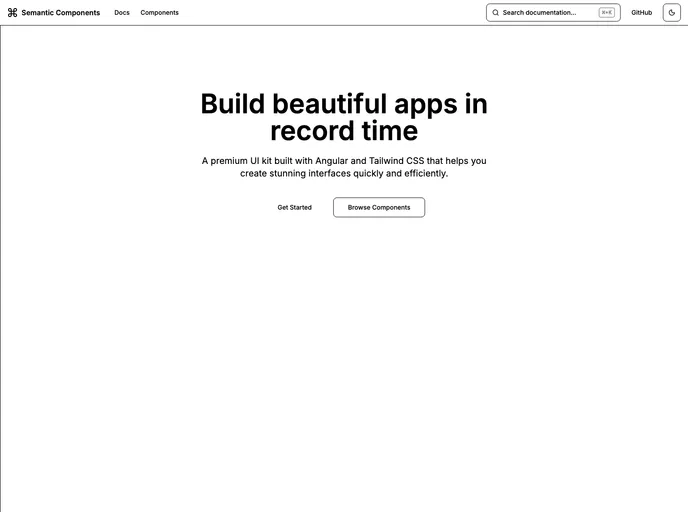



A collection of free and open source ui components ready for use in your angular projects
Overview
Semantic Components are designed to revolutionize the way we build user interfaces by providing self-contained, meaningful, and reusable UI elements. With a focus on semantic HTML and accessibility, these components aim to create a more readable and maintainable UI experience. By leveraging the capabilities of Angular CDK and Tailwind CSS, Semantic Components stand out as a powerful solution for developers looking to enhance their front-end projects.
This innovative UI library not only prioritizes design but also ensures that applications remain accessible to all users. By emphasizing modular design and proper semantics, Semantic Components transform the development process into a more efficient and collaborative effort.
Features
- Lightweight & Flexible Components: These components are optimized for performance and can be easily adapted to fit various use cases without unnecessary overhead.
- Accessibility (A11y) Support: Designed with accessibility in mind, ensuring that all users, including those with disabilities, can navigate and interact with your applications smoothly.
- Semantic Naming: Utilizes HTML elements that have intrinsic meaning, promoting better SEO practices and enhancing the overall clarity of the code.
- Encapsulation: Each component operates independently, containing its logic, UI, style, and state, which fosters a clean separation of concerns.
- Reusability: Built to be reused across different applications or components without any modifications, significantly speeding up the development cycle.
- Abstraction: Simplifies the user experience by hiding complex implementation details and exposing only the necessary interfaces, making it easier for developers to work with.
- Improved Maintainability: The modular design makes updating components straightforward, allowing for easier adjustments and enhancements.
- Enhanced Readability: By utilizing clear semantic structures, developers can quickly understand the codebase, leading to more efficient collaboration and project management.
- Angular
Angular is a TypeScript-based open-source framework by Google for building dynamic single-page applications and cross-platform mobile apps with MVC architecture and a rich set of features.
- Express
Express.js is a simple Node.js framework for single, multi-page, and hybrid web applications.
- Tailwind
Tailwind CSS is a utility-first CSS framework that provides pre-defined classes for building responsive and customizable user interfaces.
- Eslint

ESLint is a linter for JavaScript that analyzes code to detect and report on potential problems and errors, as well as enforce consistent code style and best practices, helping developers to write cleaner, more maintainable code.
- Postcss

PostCSS is a popular open-source tool that enables web developers to transform CSS styles with JavaScript plugins. It allows for efficient processing of CSS styles, from applying vendor prefixes to improving browser compatibility, ultimately resulting in cleaner, faster, and more maintainable code.
- Typescript

TypeScript is a superset of JavaScript, providing optional static typing, classes, interfaces, and other features that help developers write more maintainable and scalable code. TypeScript's static typing system can catch errors at compile-time, making it easier to build and maintain large applications.