
AstronomicAL
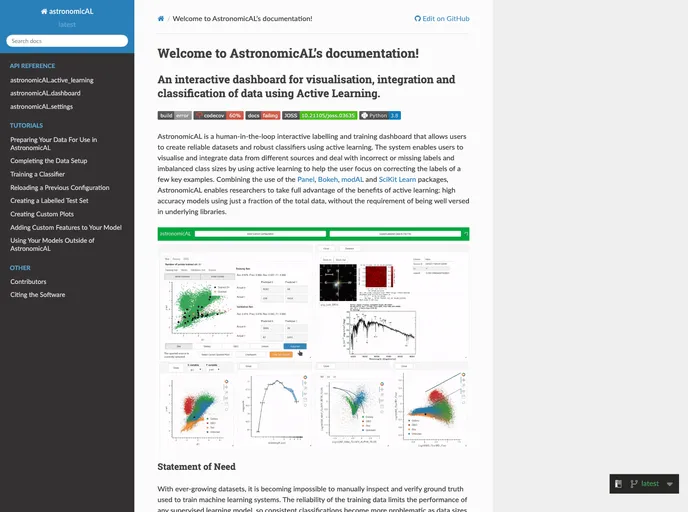
An interactive dashboard for visualisation, integration and classification of data using Active Learning.
Overview
AstronomicAL is a revolutionary interactive dashboard designed for the visualization, integration, and classification of data, harnessing the power of Active Learning. This innovative tool is tailored for researchers who are looking to create reliable datasets and robust classifiers while tackling the challenges of incorrect or missing labels and imbalanced class sizes. With AstronomicAL, users can easily visualize and work with diverse data sources, making the data labeling and training process more efficient and effective.
The system is particularly beneficial for dealing with the ever-growing datasets in fields like astronomy, where manually inspecting large volumes of data is increasingly impractical. By focusing on the most uncertain areas of data, AstronomicAL allows users to inject their domain expertise directly into the training process, ensuring accuracy and reliability of labels. Whether you are immersed in astronomical research or any other data-intensive domain, AstronomicAL can be customized to meet your specific needs.
Features
-
Human-in-the-loop Mechanism: Allows users to interactively label data, injecting their expertise into the classification process and improving model reliability.
-
Data Visualization: Offers robust visualization tools that help users explore each data point, making it easier to identify areas that require attention and correction.
-
Active Learning Integration: Employs active learning strategies to efficiently train high-accuracy models using only a fraction of the total data, freeing users from the need for extensive labeled datasets.
-
Modular and Extensible Design: Provides flexibility for researchers to customize the tool according to their research needs, including domain-specific visualizations and query strategies.
-
Robust Performance Validation: Extensively validated on astronomy datasets, ensuring reliability across various types of large scientific datasets with imbalanced classes and ambiguous definitions.
-
Data Fusion Capabilities: Supports integrating diverse data sources, allowing users to combine cataloged data with real-time data acquisition for enhanced analysis.
-
User-Friendly Interface: Designed to be accessible for users not necessarily well-versed in underlying programming libraries, ensuring a smoother onboarding experience for researchers.
-
Customizability for Various Domains: While particularly strong in astronomy, AstronomicAL is adaptable for any tabular data, making it suitable for a wide range of scientific applications.