
React Redux Saga Boilerplate


React, Styled Components, Redux, Redux Saga, Redux Little Router, Webpack, Babel frontend boilerplate. Using the "ducks" pattern for redux and saga code. Jest for testing.
Overview
If you're looking to streamline your development process for React applications, the combination of Webpack, Styled-Components, and Redux offers a robust set of tools to enhance your workflow. This setup is optimized for modern JavaScript development, bringing efficiency and scalability to your projects. With features like Hot Module Reloading and a production-ready configuration, you can develop quickly while maintaining a high-quality output.
Features
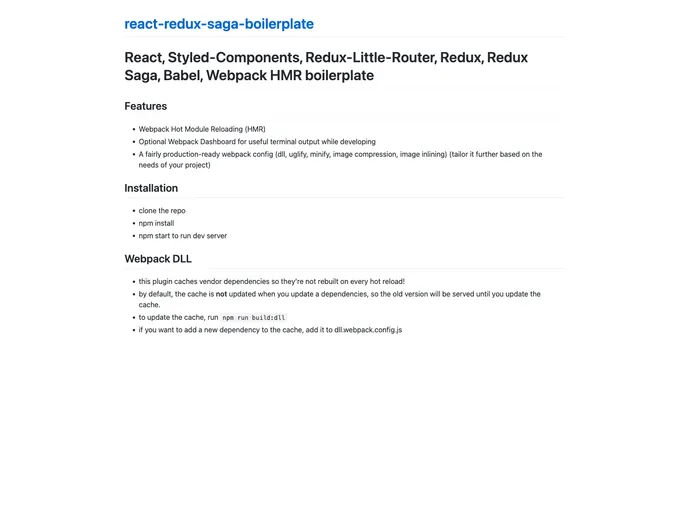
- Webpack Hot Module Reloading (HMR): Experience real-time updates in your application without losing the state, enabling a smoother development experience.
- Optional Webpack Dashboard: Gain insightful terminal feedback during development, making it easier to track build progress and issues.
- Production-Ready Configuration: Benefit from a configuration capable of handling DLL, uglification, minification, image compression, and inlining, which can be tailored to suit your project's specific requirements.
- Webpack DLL Plugin: Leverage caching for vendor dependencies to avoid lengthy rebuilds, significantly speeding up the development process.
- Quick Installation: Clone the repository and run a few simple commands to get your development server up and running in no time.
- Dependency Management: Easily update and manage cache for dependencies, allowing for precise control over asset versions within the development lifecycle.
- React
React is a widely used JavaScript library for building user interfaces and single-page applications. It follows a component-based architecture and uses a virtual DOM to efficiently update and render UI components
- Styled Components
Styled Components is a popular library for styling React components using CSS syntax. It allows you to write CSS in your JavaScript code, making it easier to create dynamic styles that are specific to each component.
- Templates & Themes

A template or theme refers to a pre-designed layout or structure that provides a basic framework for building a specific type of application or website. It typically includes good design, placeholder content and functional features, allowing developers to customize and fill in the details according to their specific needs.
- Eslint

ESLint is a linter for JavaScript that analyzes code to detect and report on potential problems and errors, as well as enforce consistent code style and best practices, helping developers to write cleaner, more maintainable code.
- Redux
Redux is a state management library for JavaScript apps that provides a predictable and centralized way to manage application state. It enables developers to write actions and reducers that update the state in response to user interactions, server responses, and other events, and can be used with a variety of front-end frameworks and back-end technologies.
- Webpack

Webpack is a popular open-source module bundler for JavaScript applications that bundles and optimizes the code and its dependencies for production-ready deployment. It can also be used to transform other types of assets such as CSS, images, and fonts.