
Gramps Web Api
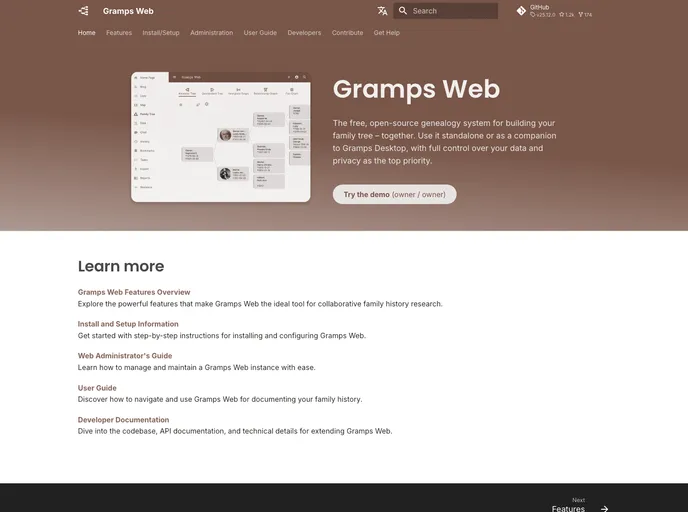

A RESTful web API for Gramps - backend of Gramps Web
Overview
Gramps Web API is a powerful Python-based REST API designed to interact with Gramps family tree databases over the web. This API serves as the backbone for the Gramps Web application—a genealogy web app leveraging the capabilities of Gramps. Its flexibility also allows it to be utilized as a backend for various other tools aimed at managing family trees and genealogical data.
With the ability to query and manipulate data easily, Gramps Web API simplifies the way users can manage and access their genealogical information, making it a must-have for both developers and genealogy enthusiasts who rely on Gramps to chart their family history.
Features
- RESTful API: Built as a REST API, it follows standard conventions for web services, making it easy to use and integrate with other applications.
- Data Manipulation: Enables users to easily query, add, update, and delete entries in a Gramps family tree database, providing full control over genealogical data.
- Compatibility: Acts as a backend for Gramps Web, while also supporting connections with other tools, enhancing its versatility in genealogy data management.
- Python-Based: Leveraging Python's extensive libraries and frameworks, it ensures robust performance and ease of development for additional features.
- Community Support: As part of the Gramps project, it benefits from a vibrant community, offering ample resources and documentation for developers and users alike.
- Extensible: The API is designed to be easily extended, allowing developers to customize functions to meet specific needs within genealogy applications.
- Mobile Friendly: Optimized for web use, making it accessible from mobile devices, which is perfect for on-the-go family history research.
- Flask
Flask is a lightweight and popular web framework for Python, known for its simplicity and flexibility. It is widely used to build web applications, providing a minimalistic approach to web development with features like routing, templates, and support for extensions.