
Comcat Engineering
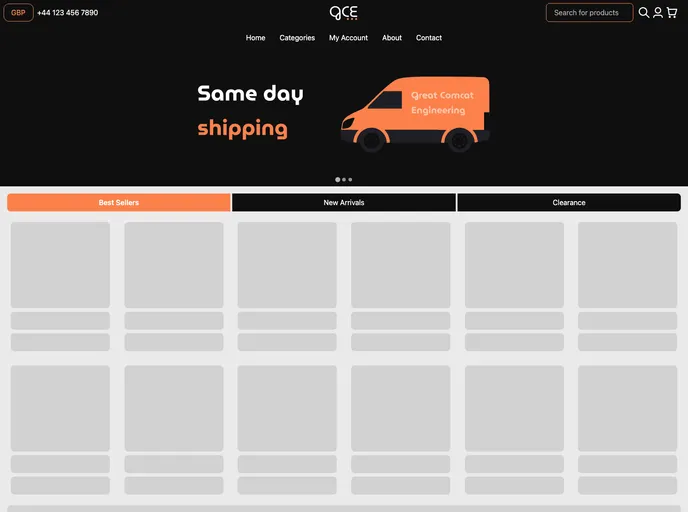


Website of Great Comcat Engineering LTD built Next.js, Tailwind CSS, MongoDB and Framer Motion.
Overview:
Great Comcat Engineering is an e-commerce website based in London, UK. This website was built using Next.js, Framer Motion, Tailwind CSS, and MongoDB for the backend. It provides an online platform for Great Comcat Engineering LTD to showcase and sell their products.
Features:
- Next.js: Utilized for building a server-side rendered React application, providing fast and seamless user experience.
- Framer Motion: Integrated for creating smooth and interactive animations, enhancing the overall user interface.
- Tailwind CSS: Employed for efficient and customizable styling, ensuring a visually appealing and responsive design.
- MongoDB: Used as the backend database system for storing and managing website data, enabling efficient retrieval and manipulation.
Summary:
Great Comcat Engineering is an e-commerce website built using Next.js, Framer Motion, Tailwind CSS, and MongoDB. With features like server-side rendering, smooth animations, customizable styling, and efficient data storage, it provides a seamless and visually appealing online platform for Great Comcat Engineering LTD to showcase and sell their products. To install the website, clone the repository, install dependencies, and follow the provided commands for running, building, exporting, and deploying the website.
- Next.js
Next.js is a React-based web framework that enables server-side rendering, static site generation, and other powerful features for building modern web applications.
- React
React is a widely used JavaScript library for building user interfaces and single-page applications. It follows a component-based architecture and uses a virtual DOM to efficiently update and render UI components
- Tailwind
Tailwind CSS is a utility-first CSS framework that provides pre-defined classes for building responsive and customizable user interfaces.
- Headless UI
Headless UI is a set of completely unstyled, fully accessible UI components for React, Vue, and Alpine.js that empower developers to build their own fully accessible custom UI components. Headless UI allows developers to focus on building accessible and highly functional user interfaces, without the need to worry about styling or layout.
- Ecommerce

Ecommerce websites sell products or services to customers through an online storefront. These websites typically include features such as product listings, shopping carts, payment processing, and order management tools.
- Eslint

ESLint is a linter for JavaScript that analyzes code to detect and report on potential problems and errors, as well as enforce consistent code style and best practices, helping developers to write cleaner, more maintainable code.
- Framer Motion

Alpine.js is a lightweight JavaScript framework that simplifies the process of creating dynamic, reactive user interfaces on the web. It uses a declarative syntax that offers a higher level of abstraction compared to vanilla JavaScript, while being more performant and easier to use than jQuery.
- Postcss

PostCSS is a popular open-source tool that enables web developers to transform CSS styles with JavaScript plugins. It allows for efficient processing of CSS styles, from applying vendor prefixes to improving browser compatibility, ultimately resulting in cleaner, faster, and more maintainable code.
- React Hook Form

React Hook Form is a performant, flexible, and extensible form library for React with easy validation. It reduces re-renders and improves performance by using uncontrolled components and native HTML validation, making form handling simple and efficient.
- Typescript

TypeScript is a superset of JavaScript, providing optional static typing, classes, interfaces, and other features that help developers write more maintainable and scalable code. TypeScript's static typing system can catch errors at compile-time, making it easier to build and maintain large applications.