
Gitea
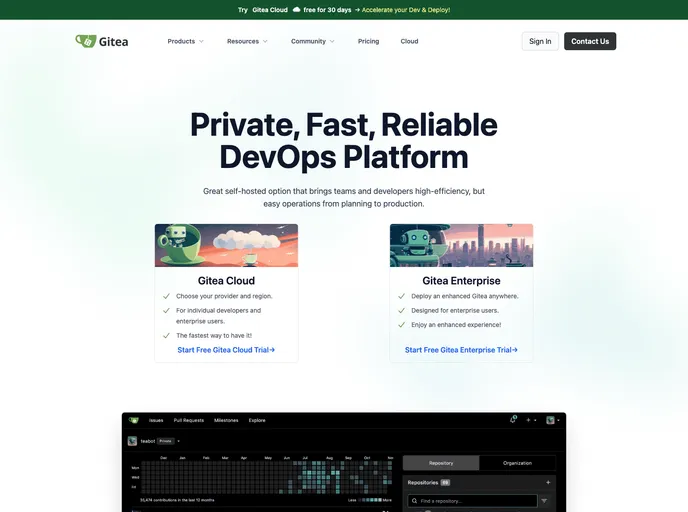


Git with a cup of tea! Painless self-hosted all-in-one software development service, including Git hosting, code review, team collaboration, package registry and CI/CD
Overview
Gitea is an impressive self-hosted Git service designed for simplicity and efficiency. Written in Go, it ensures compatibility across various platforms, including Linux, macOS, and Windows, making it a flexible option for developers. Since its inception as a fork of Gogs in 2016, Gitea has evolved significantly, offering a robust solution for version control that is both easy to deploy and manage.
In addition to its user-friendly interface and straightforward setup process, Gitea provides extensive documentation, ensuring that users can quickly harness its features. Whether you're looking to organize your repositories or need a reliable service for collaborative coding, Gitea stands out as a top choice in the self-hosted Git service realm.
Features
-
Cross-Platform Support: Gitea runs seamlessly on various operating systems including Linux, macOS, and Windows, alongside multiple architectures like x86 and ARM.
-
Fast Setup: Designed for ease of use, Gitea promotes a swift installation process to get developers up and running without delays.
-
Extensive Documentation: Comprehensive guides are available to aid users in installation, administration, and utilizing Gitea’s features effectively.
-
Community Contributions: Gitea encourages user engagement through contributions, with a clear workflow for submitting patches and improvements.
-
Translation Support: Built-in tools for translation allow users to contribute in multiple languages, fostering a global community.
-
Official SDKs and Tools: Gitea offers various official tools, including a CLI and action runners, as well as a list of third-party projects to enhance functionality.
-
Cloud Deployment Option: Users can quickly deploy Gitea on Gitea Cloud, experiencing the service without initial installation hassle, thanks to a free trial option.
-
API Support: Gitea comes with experimental API options, enabling developers to integrate it with other applications for enhanced workflows.
- Vue
Vue.js is a lightweight and flexible JavaScript framework that allows developers to easily build dynamic and reactive user interfaces. Its intuitive syntax, modular architecture, and focus on performance make it a popular choice for modern web development.
- Tailwind
Tailwind CSS is a utility-first CSS framework that provides pre-defined classes for building responsive and customizable user interfaces.
- Eslint

ESLint is a linter for JavaScript that analyzes code to detect and report on potential problems and errors, as well as enforce consistent code style and best practices, helping developers to write cleaner, more maintainable code.
- Postcss

PostCSS is a popular open-source tool that enables web developers to transform CSS styles with JavaScript plugins. It allows for efficient processing of CSS styles, from applying vendor prefixes to improving browser compatibility, ultimately resulting in cleaner, faster, and more maintainable code.
- Stylelint
Stylelint is a modern linter for CSS that helps you avoid errors and enforce consistent styling conventions. It provides rules for detecting errors and warnings, and can be configured to match your specific project's requirements.
- Typescript

TypeScript is a superset of JavaScript, providing optional static typing, classes, interfaces, and other features that help developers write more maintainable and scalable code. TypeScript's static typing system can catch errors at compile-time, making it easier to build and maintain large applications.
- Webpack

Webpack is a popular open-source module bundler for JavaScript applications that bundles and optimizes the code and its dependencies for production-ready deployment. It can also be used to transform other types of assets such as CSS, images, and fonts.