
Vue Github Buttons
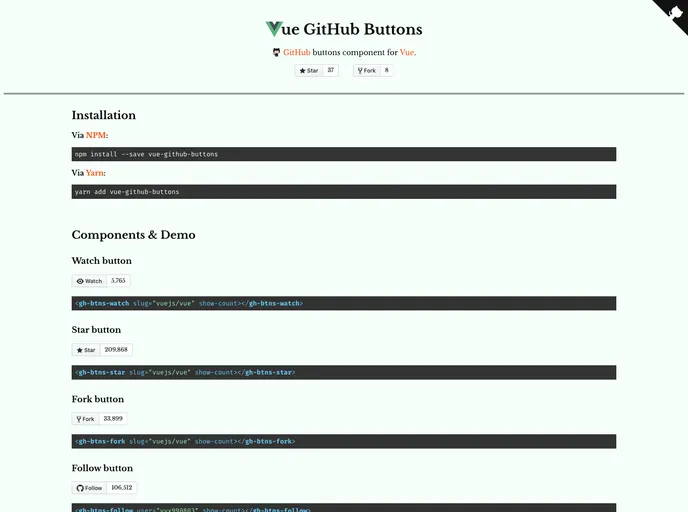


:octocat: GitHub buttons component for Vue.
Overview
If you’re looking for a way to incorporate GitHub buttons into your Vue applications seamlessly, the Vue GitHub Buttons component is a fantastic choice. This tool enables developers to easily integrate various GitHub functionalities, enhancing user interaction and engagement with repositories. Built with Vue 2 and available via NPM, this lightweight component allows you to display buttons for watching, starring, forking, and following GitHub projects, making it an essential addition for any GitHub-centric site.
Not only does the Vue GitHub Buttons component cater to functionality, but it also supports integration with popular frameworks like Nuxt and VuePress. With straightforward installation and easy-to-use options, it simplifies the process of enhancing your application’s functionality without compromising on style or performance.
Features
-
Easy Installation: Install via NPM or Yarn with simple commands to get started quickly.
-
Multiple Button Types: Includes components for watch, star, fork, and follow actions that cater to all your GitHub interaction needs.
-
Cache Management: Optional caching feature helps to minimize API calls and enhance performance by using session storage for count numbers.
-
Nuxt Integration: Simple setup for Nuxt projects by adding the component to your modules in
nuxt.config.js. -
VuePress Compatibility: Easily integrate with VuePress by configuring your plugins in
.vuepress/config.js. -
Customizable Options: Each button component allows customization through props, letting you enable or disable the display of counts based on your preferences.
-
Lightweight and Efficient: The component is designed to be efficient without bloating your application, ensuring quick load times.
-
Active Community Support: Being a part of the Vue ecosystem means you have access to active community support and updates.
- Vue
Vue.js is a lightweight and flexible JavaScript framework that allows developers to easily build dynamic and reactive user interfaces. Its intuitive syntax, modular architecture, and focus on performance make it a popular choice for modern web development.
- SCSS
SCSS is a preprocessor scripting language that extends the capabilities of CSS by adding features such as variables, nesting, and mixins. It allows developers to write more efficient and maintainable CSS code, and helps to streamline the development process by reducing repetition and increasing reusability.
- Typescript

TypeScript is a superset of JavaScript, providing optional static typing, classes, interfaces, and other features that help developers write more maintainable and scalable code. TypeScript's static typing system can catch errors at compile-time, making it easier to build and maintain large applications.
- Webpack

Webpack is a popular open-source module bundler for JavaScript applications that bundles and optimizes the code and its dependencies for production-ready deployment. It can also be used to transform other types of assets such as CSS, images, and fonts.