
Gssoc Website New
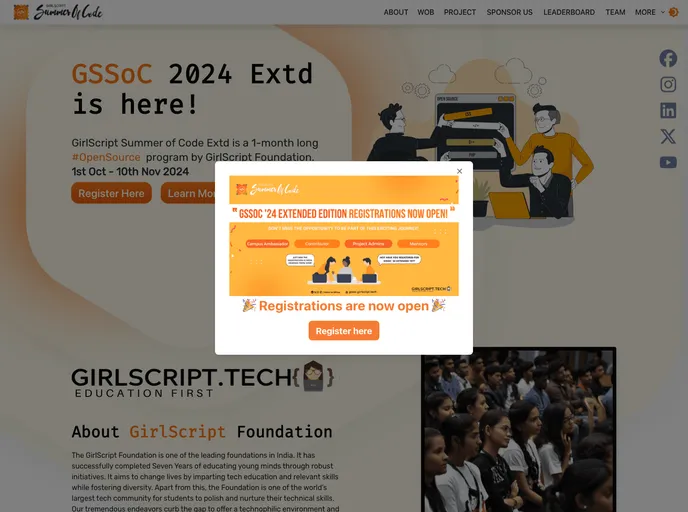


GSSoC'23 Official Website
Overview
The official website repository for the GirlScript Summer of Code 2023 (GSSoC'23) is a three-month-long Open-Source Program conducted every summer by the Girlscript Foundation. Participants contribute to numerous projects under the guidance of skilled mentors from their homes. The 2023 edition aims to continue the legacy with a promising impact. The website is built using Next.js and TailwindCSS framework, and it supports both light and dark themes.
Features
- Open-source program conducted by Girlscript Foundation every summer.
- Three-month-long program with skilled mentors guiding participants.
- Participants contribute to real-world projects from home.
- Built using Next.js and TailwindCSS framework.
- Supports both light and dark themes.
- Custom CSS used in addition to inline Tailwind styles.
- Project structure includes separate directories for pages, API routes, and components.
- Public directory contains all assets used in the project.
Summary
The GirlScript Summer of Code 2023 (GSSoC'23) is an open-source program conducted by the Girlscript Foundation. It provides an opportunity for participants to contribute to real-world projects under the guidance of skilled mentors. The program is conducted over three months, and participants can work from the comfort of their homes. The official website for GSSoC'23 is built using Next.js and TailwindCSS, and it supports both light and dark themes. The website structure includes separate directories for pages, API routes, and components, and the public directory contains all the project assets. To set up the development environment, the required node modules and dependencies need to be installed, and the development server can be run locally. With its promising impact, GSSoC'23 continues the legacy of active participation in the GirlScript Summer of Code program.
- Next.js
Next.js is a React-based web framework that enables server-side rendering, static site generation, and other powerful features for building modern web applications.
- React
React is a widely used JavaScript library for building user interfaces and single-page applications. It follows a component-based architecture and uses a virtual DOM to efficiently update and render UI components
- Styled Components
Styled Components is a popular library for styling React components using CSS syntax. It allows you to write CSS in your JavaScript code, making it easier to create dynamic styles that are specific to each component.
- Tailwind
Tailwind CSS is a utility-first CSS framework that provides pre-defined classes for building responsive and customizable user interfaces.
- Chakra UI
Chakra UI is a popular open-source React component library that provides a set of accessible and customizable UI components to help developers create modern web applications.
- Headless UI
Headless UI is a set of completely unstyled, fully accessible UI components for React, Vue, and Alpine.js that empower developers to build their own fully accessible custom UI components. Headless UI allows developers to focus on building accessible and highly functional user interfaces, without the need to worry about styling or layout.
- Eslint

ESLint is a linter for JavaScript that analyzes code to detect and report on potential problems and errors, as well as enforce consistent code style and best practices, helping developers to write cleaner, more maintainable code.
- Framer Motion

Alpine.js is a lightweight JavaScript framework that simplifies the process of creating dynamic, reactive user interfaces on the web. It uses a declarative syntax that offers a higher level of abstraction compared to vanilla JavaScript, while being more performant and easier to use than jQuery.
- Postcss
PostCSS is a popular open-source tool that enables web developers to transform CSS styles with JavaScript plugins. It allows for efficient processing of CSS styles, from applying vendor prefixes to improving browser compatibility, ultimately resulting in cleaner, faster, and more maintainable code.