
Next App Nextra Template
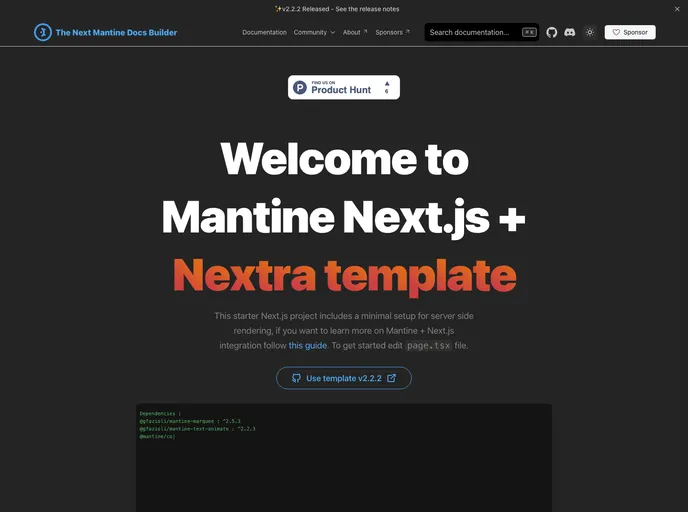



Template for NextJS app router + Mantine UI + Nextra
Overview
The Mantine Next.js + Nextra template is an impressive solution designed for developers looking to create a documentation site utilizing Next.js app router combined with Mantine and Nextra. This template streamlines the process of setting up a documentation site, providing a robust framework right out of the box. With modern features and a focus on developer experience, it aims to enhance productivity and maintainability for both individual developers and teams.
This template caters to both aesthetics and functionality, supporting features like dark mode synchronization and customizable components. By simplifying the folder structure and including essential scripts, it lays a solid foundation for users to build upon, ensuring that they can focus on content rather than setup intricacies.
Features
-
PostCSS with mantine-postcss-preset: Enhance your styling capabilities with an efficient PostCSS setup tailored for Mantine.
-
TypeScript Support: Embrace type safety in your development process, making your codebase more robust and easier to maintain.
-
Storybook Integration: Test and develop UI components in isolation with Storybook, a powerful tool for component-driven development.
-
Jest Setup with React Testing Library: Ensure quality and reliability with a seamless testing infrastructure for your React components.
-
Customizable Components: Utilize a dedicated components folder with pre-built components that you can easily adapt to meet your specific needs.
-
Nextra Documentation Site: Leverage the functionality of Nextra to create a smooth and efficient documentation experience, complete with a Mantine theme.
-
Dark Mode Synchronization: Provide a cohesive user experience by syncing dark mode settings between your documentation and application.
-
Comprehensive npm Scripts: Benefit from a suite of development scripts to streamline the build, testing, and development processes, including type checks and linting.
- Next.js
Next.js is a React-based web framework that enables server-side rendering, static site generation, and other powerful features for building modern web applications.
- Nextra
Nextra is a Next.js-based static site generator optimized for documentation and blogs. It provides MDX support, automatic sidebar generation, full-text search, and beautiful themes with minimal configuration.
- React
React is a widely used JavaScript library for building user interfaces and single-page applications. It follows a component-based architecture and uses a virtual DOM to efficiently update and render UI components
- Mantine UI
A fully featured React components library. 100+ components, 50+ hooks.
- Eslint

ESLint is a linter for JavaScript that analyzes code to detect and report on potential problems and errors, as well as enforce consistent code style and best practices, helping developers to write cleaner, more maintainable code.
- MDX

MDX is a format that allows developers to write JSX within Markdown documents, combining the power of React with the simplicity of Markdown. This allows for the creation of dynamic and interactive content that can be easily shared and consumed across different platforms and devices.
- Postcss

PostCSS is a popular open-source tool that enables web developers to transform CSS styles with JavaScript plugins. It allows for efficient processing of CSS styles, from applying vendor prefixes to improving browser compatibility, ultimately resulting in cleaner, faster, and more maintainable code.
- Storybook
Storybook is a tool for developing and testing UI components in isolation. It provides a sandbox environment where you can experiment with different props and states to see how your component responds.
- Stylelint
Stylelint is a modern linter for CSS that helps you avoid errors and enforce consistent styling conventions. It provides rules for detecting errors and warnings, and can be configured to match your specific project's requirements.
- Typescript

TypeScript is a superset of JavaScript, providing optional static typing, classes, interfaces, and other features that help developers write more maintainable and scalable code. TypeScript's static typing system can catch errors at compile-time, making it easier to build and maintain large applications.