
Mantine Parallax
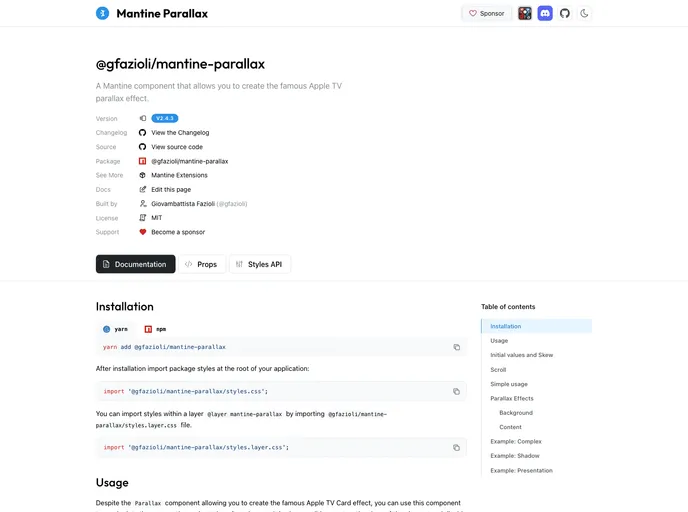




A Mantine UI Library Extension Parallax component to replicate the Apple TV Card
Overview
The Mantine Parallax Component is an innovative addition to the Mantine library, designed to bring captivating motion effects to user interfaces. This component is perfect for developers looking to enhance interactivity within their applications. With its ability to create immersive experiences through 3D transformations and hover effects, Mantine Parallax transforms the way designers and developers can engage users. The component has a variety of props that allow for significant customization, making it versatile for various use cases.
One standout feature is its integration with scroll-driven interactions, enabling animations to respond dynamically to user scrolling. This capability ensures that each element feels alive and synchronized with the user's actions, enhancing the overall user experience. Whether you're interested in creating striking cards, banners, or panels, Mantine Parallax provides the tools necessary to design responsive and visually stunning UI components effortlessly.
Features
-
Flexible Motion Effects: Create a range of interactive motion effects, from classic tilts to sophisticated 3D transformations.
-
Customizable Props: Fine-tune depth and response with props for perspective, rotation, skew, and light effects, giving developers precise control over animations.
-
Scroll-Driven Interactions: Utilize the
useWindowScrollhook to tie transformations to scroll position, making UI elements reactive to user movement. -
Independent Background Parallax: Achieve layered scenes with independent parallax effects for backgrounds, enhancing depth and immersion.
-
Guardrails for Control: Set disabled states or use large initial perspective values to prevent extreme configurations, ensuring a stable user experience.
-
CSS Layer Integration: Simplify styling and integration via provided CSS layers, allowing for quick implementation without compromising design.
-
Active Maintenance: The project is regularly updated, providing a reliable and evolving toolset for developers, supported by community sponsorship.
- Next.js
Next.js is a React-based web framework that enables server-side rendering, static site generation, and other powerful features for building modern web applications.
- React
React is a widely used JavaScript library for building user interfaces and single-page applications. It follows a component-based architecture and uses a virtual DOM to efficiently update and render UI components
- Vite
Vite is a build tool that aims to provide a faster and leaner development experience for modern web projects
- Mantine UI
A fully featured React components library. 100+ components, 50+ hooks.
- Eslint

ESLint is a linter for JavaScript that analyzes code to detect and report on potential problems and errors, as well as enforce consistent code style and best practices, helping developers to write cleaner, more maintainable code.
- GitHub Pages

Gridsome is a Vue.js-based static site generator that makes it easy to build fast and flexible websites and applications by leveraging modern web technologies like GraphQL, Webpack, and hot reloading
- Postcss

PostCSS is a popular open-source tool that enables web developers to transform CSS styles with JavaScript plugins. It allows for efficient processing of CSS styles, from applying vendor prefixes to improving browser compatibility, ultimately resulting in cleaner, faster, and more maintainable code.
- Rollup

RollupJS is a popular and efficient JavaScript module bundler that takes the code from multiple modules and packages them into a single optimized file, minimizing the overall size of the application and improving its performance.
- Storybook
Storybook is a tool for developing and testing UI components in isolation. It provides a sandbox environment where you can experiment with different props and states to see how your component responds.
- Stylelint
Stylelint is a modern linter for CSS that helps you avoid errors and enforce consistent styling conventions. It provides rules for detecting errors and warnings, and can be configured to match your specific project's requirements.
- Typescript

TypeScript is a superset of JavaScript, providing optional static typing, classes, interfaces, and other features that help developers write more maintainable and scalable code. TypeScript's static typing system can catch errors at compile-time, making it easier to build and maintain large applications.