
Mantine Flip
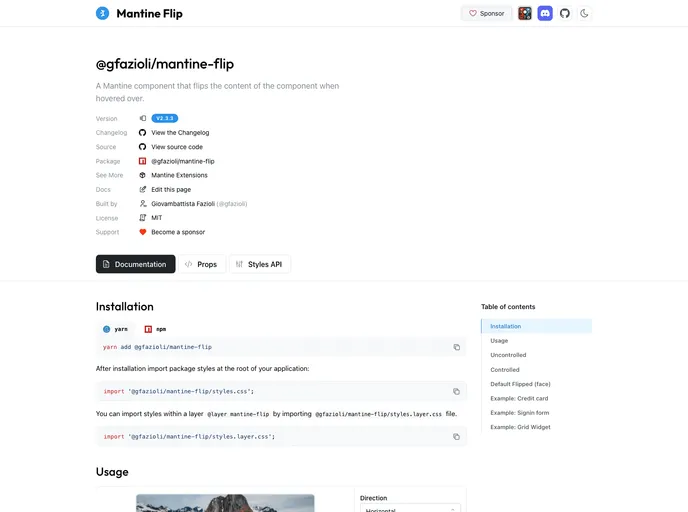




A Mantine UI Library Extension Flip component
Overview
The Mantine Flip component provides an engaging way to create UI elements that can efficiently toggle between two states. Perfect for applications that prioritize progressive disclosure, such as editing panels or profile detail toggles, this component delivers both functionality and aesthetics. With its easy-to-use interface based on the Mantine library, developers can quickly implement intuitive interactions within their apps.
What sets the Mantine Flip component apart is its flexibility in usage. It supports both uncontrolled and controlled implementations, making it suitable for a variety of use cases. Whether you want to keep it simple or fully integrate the component with your app's state management, Mantine Flip has got you covered.
Features
-
Two-Face Animation: The component seamlessly animates between front and back views, enhancing user interaction while conserving space in your UI.
-
Uncontrolled and Controlled Modes: Use
Flip.Targetto trigger animations with any element in uncontrolled mode, or manage the flips directly through your React state for controlled functionality. -
Custom Transition Options: Personalize the flipping experience with customizable transitions, including vertical flips and specific rotation directions for smooth animations.
-
Refined Styling Hooks: Utilize classNames and the Styles API to target inner component parts for tailored styling, ensuring your design aligns perfectly with your application's aesthetics.
-
Practical Examples: The component comes with demonstrative patterns, showcasing its utility in various scenarios like credit-card editing or modal settings panes.
-
Size Constraints: Enforce size restrictions for the component, providing the necessary adaptability for different layout needs within your app.
-
Sponsorship Support: Backing this open-source project not only helps maintain its active development but also encourages contributions that enhance its capabilities over time.
- Next.js
Next.js is a React-based web framework that enables server-side rendering, static site generation, and other powerful features for building modern web applications.
- React
React is a widely used JavaScript library for building user interfaces and single-page applications. It follows a component-based architecture and uses a virtual DOM to efficiently update and render UI components
- Vite
Vite is a build tool that aims to provide a faster and leaner development experience for modern web projects
- Mantine UI
A fully featured React components library. 100+ components, 50+ hooks.
- Eslint

ESLint is a linter for JavaScript that analyzes code to detect and report on potential problems and errors, as well as enforce consistent code style and best practices, helping developers to write cleaner, more maintainable code.
- GitHub Pages

Gridsome is a Vue.js-based static site generator that makes it easy to build fast and flexible websites and applications by leveraging modern web technologies like GraphQL, Webpack, and hot reloading
- Postcss

PostCSS is a popular open-source tool that enables web developers to transform CSS styles with JavaScript plugins. It allows for efficient processing of CSS styles, from applying vendor prefixes to improving browser compatibility, ultimately resulting in cleaner, faster, and more maintainable code.
- Rollup

RollupJS is a popular and efficient JavaScript module bundler that takes the code from multiple modules and packages them into a single optimized file, minimizing the overall size of the application and improving its performance.
- Storybook
Storybook is a tool for developing and testing UI components in isolation. It provides a sandbox environment where you can experiment with different props and states to see how your component responds.
- Stylelint
Stylelint is a modern linter for CSS that helps you avoid errors and enforce consistent styling conventions. It provides rules for detecting errors and warnings, and can be configured to match your specific project's requirements.
- Typescript

TypeScript is a superset of JavaScript, providing optional static typing, classes, interfaces, and other features that help developers write more maintainable and scalable code. TypeScript's static typing system can catch errors at compile-time, making it easier to build and maintain large applications.