
Sentry
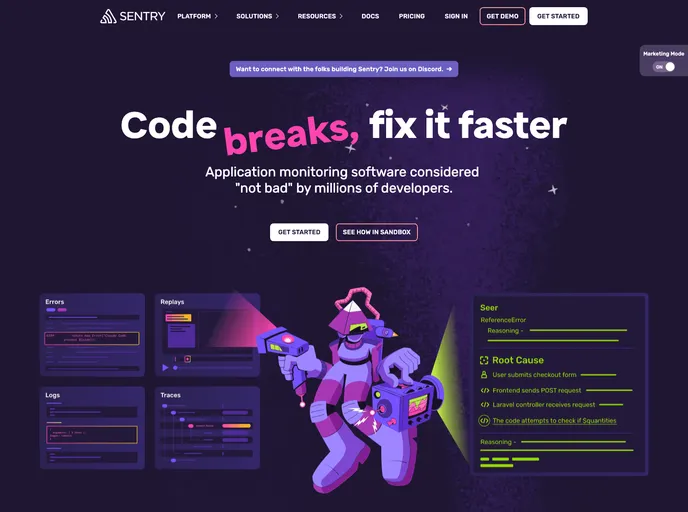



Developer-first error tracking and performance monitoring
Overview
Sentry is a powerful debugging platform that streamlines the process of detecting, tracing, and fixing issues in your code. With its focus on helping developers respond swiftly when code breaks, Sentry enables a more efficient workflow, significantly reducing downtime and improving overall productivity. Whether you're working on a small project or a large application, having Sentry integrated into your development process can be a game-changer.
This platform supports a wide array of programming languages and frameworks, making it versatile for various development environments. From JavaScript to C++, Sentry's Official SDKs cover a broad spectrum, ensuring that developers across different technologies can benefit from its robust debugging capabilities.
Features
-
Comprehensive SDK Support: Sentry offers SDKs for a wide range of programming languages including JavaScript, Python, Ruby, Go, and more, allowing for easy integration into diverse codebases.
-
Real-Time Error Tracking: Instantly detect and report errors in your applications, enabling developers to quickly address issues before they escalate.
-
Detailed Issue Reports: Each error or bug comes with extensive details such as stack traces and contextual information, which aids in diagnosing problems faster.
-
Performance Monitoring: In addition to error tracking, Sentry provides performance insights that help developers understand how their code performs in production.
-
User Feedback Integration: Collect feedback from users directly related to issues, offering additional context that can guide developers in troubleshooting.
-
Collaboration Tools: Sentry supports discussions, allowing teams to share insights, report bugs, and request features directly within the platform.
-
Active Community and Resources: Access an extensive documentation library, forums, and resources that foster community engagement and knowledge sharing.
-
Customization Options: Tailor alerts and notifications according to your team’s needs, ensuring the right people are informed about issues as they arise.
- Django
Django is a high-level Python web framework that encourages rapid development and clean, pragmatic design. It follows the model-view-controller (MVC) architectural pattern, providing an extensive set of built-in tools and conventions to streamline the creation of robust and scalable web applications.
- React
React is a widely used JavaScript library for building user interfaces and single-page applications. It follows a component-based architecture and uses a virtual DOM to efficiently update and render UI components
- TanStack
TanStack is a collection of high-quality, framework-agnostic libraries including TanStack Query for data fetching, TanStack Router for routing, TanStack Table for tables, and more. These tools provide powerful, type-safe solutions for common web development challenges.
- LESS
Less CSS is a dynamic stylesheet language that extends the capabilities of CSS, allowing developers to write cleaner, more modular, and reusable stylesheets with features like variables, mixins, and nested rules.
- Eslint

ESLint is a linter for JavaScript that analyzes code to detect and report on potential problems and errors, as well as enforce consistent code style and best practices, helping developers to write cleaner, more maintainable code.
- Framer Motion

Alpine.js is a lightweight JavaScript framework that simplifies the process of creating dynamic, reactive user interfaces on the web. It uses a declarative syntax that offers a higher level of abstraction compared to vanilla JavaScript, while being more performant and easier to use than jQuery.
- MDX

MDX is a format that allows developers to write JSX within Markdown documents, combining the power of React with the simplicity of Markdown. This allows for the creation of dynamic and interactive content that can be easily shared and consumed across different platforms and devices.
- Mobx

MobX is a simple and scalable state management library for JavaScript applications. It uses reactive programming techniques to automatically update the user interface in response to changes in the application state, making it easy to build complex and dynamic user interfaces with minimal code.
- Prism JS

PrismJS is an open-source, lightweight, and extensible syntax highlighting library that supports a wide range of programming languages and markup formats.
- Stylelint
Stylelint is a modern linter for CSS that helps you avoid errors and enforce consistent styling conventions. It provides rules for detecting errors and warnings, and can be configured to match your specific project's requirements.
- Typescript

TypeScript is a superset of JavaScript, providing optional static typing, classes, interfaces, and other features that help developers write more maintainable and scalable code. TypeScript's static typing system can catch errors at compile-time, making it easier to build and maintain large applications.