
Geonetwork UI
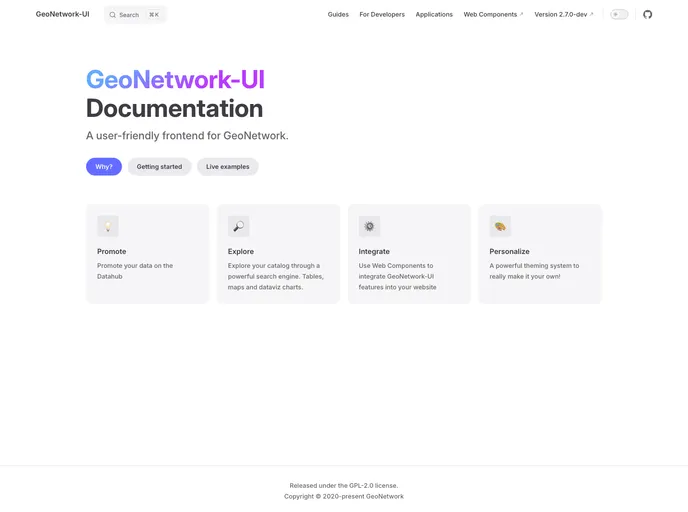




GeoNetwork UI is a suite of Applications made to provide a modern facade to your GeoNetwork 4 catalog. It also provides Web Components to embed various parts of your data catalog in third party websites.
Overview
GeoNetwork-UI is an innovative tool designed to enhance the usability of your GeoNetwork catalog. It offers a suite of applications and web components aimed at providing smoother navigation and improved user interaction. Whether you’re an end user or a developer, GeoNetwork-UI opens up a world of possibilities to better showcase and manage geospatial data.
Though primarily targeted towards developers, the user-friendly interface beckons non-technical users as well. With a focus on customization and easy integration into third-party websites, this solution promises to streamline the data catalog experience while encouraging a collaborative community through forums and discussions.
Features
-
User-Friendly Interface: Intuitive design that simplifies navigation and improves the overall user experience with the catalog.
-
Web Components: Easily embed various data catalog elements into external websites, enhancing accessibility and reach of your data.
-
Local Development Setup: Quick setup process using Docker or from source to get the applications running locally with just a few commands.
-
Interactive Storybook: Explore and interact with UI components individually, making it easier to understand features before integrating them into applications.
-
Robust Testing Support: Comprehensive testing framework using Jest for unit tests, ensuring stability and quality of the applications.
-
Community Engagement: Active forums and GitHub discussions encourage user and developer interaction, fostering a collaborative environment.
-
Production Build Process: Streamlined build process for applications, with artifacts stored neatly in a dedicated directory for easy management.
-
Configurable Backend: Flexible proxy configuration to allow for easy adjustment of backend GeoNetwork instances as needed.
- Angular
Angular is a TypeScript-based open-source framework by Google for building dynamic single-page applications and cross-platform mobile apps with MVC architecture and a rich set of features.
- Express
Express.js is a simple Node.js framework for single, multi-page, and hybrid web applications.
- Vitepress
VitePress is a static site generator designed for creating documentation websites. It offers a lightweight and fast development experience using Vue.js and Markdown, with features such as live-reload, theming, and customizable layout components.
- Tailwind
Tailwind CSS is a utility-first CSS framework that provides pre-defined classes for building responsive and customizable user interfaces.
- Eslint

ESLint is a linter for JavaScript that analyzes code to detect and report on potential problems and errors, as well as enforce consistent code style and best practices, helping developers to write cleaner, more maintainable code.
- GitHub Pages

Gridsome is a Vue.js-based static site generator that makes it easy to build fast and flexible websites and applications by leveraging modern web technologies like GraphQL, Webpack, and hot reloading
- Postcss

PostCSS is a popular open-source tool that enables web developers to transform CSS styles with JavaScript plugins. It allows for efficient processing of CSS styles, from applying vendor prefixes to improving browser compatibility, ultimately resulting in cleaner, faster, and more maintainable code.
- Storybook
Storybook is a tool for developing and testing UI components in isolation. It provides a sandbox environment where you can experiment with different props and states to see how your component responds.
- Typescript

TypeScript is a superset of JavaScript, providing optional static typing, classes, interfaces, and other features that help developers write more maintainable and scalable code. TypeScript's static typing system can catch errors at compile-time, making it easier to build and maintain large applications.