
React Spotify
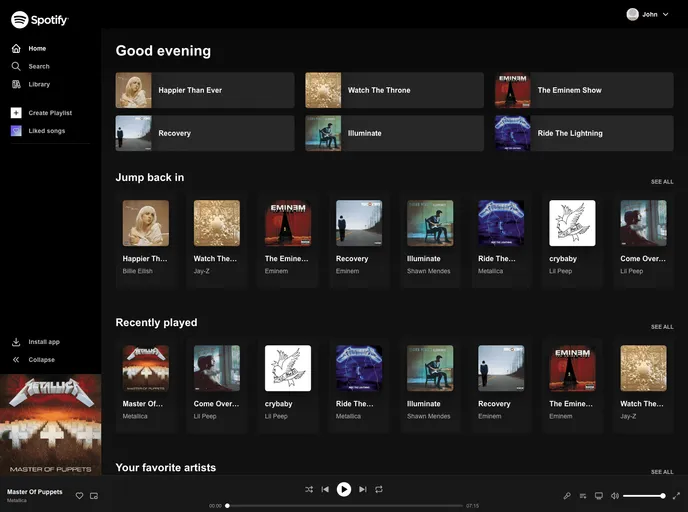





An Spotify Clone created with React, NextJS and Redux.
Overview
The Spotify Clone built using React, NextJS, and Redux is an impressive attempt to replicate the beloved music streaming experience. While it does not aim to be an exact replica, it captures the essential features that give users the familiar Spotify feel. This project is still in active development, meaning you can expect continuous improvements and new features in future updates.
If you're interested in exploring a well-structured codebase that showcases modern web development practices, this Spotify clone is worth checking out. With a robust tech stack and regular updates on the horizon, it promises to be a valuable resource for developers and music enthusiasts alike.
Features
- React & Redux: Utilizes these powerful libraries for efficient client-side rendering and state management.
- NextJS: Implements server-side rendering (SSR) and static site generation (SSG) for optimal performance and SEO capabilities.
- Mantine Integration: Leverages Mantine for styling, layout, and theming, providing a modern and responsive user interface.
- Regular Updates: The project is actively maintained, ensuring users have access to the latest features and improvements.
- Demo Availability: A demo version allows users to test the application firsthand before diving into the code.
- Easy Deployment: The project is deployed using Vercel, making it straightforward to host and share.
- MIT License: Open-source under the MIT License, encouraging collaboration and modification by other developers.
- Next.js
Next.js is a React-based web framework that enables server-side rendering, static site generation, and other powerful features for building modern web applications.
- React
React is a widely used JavaScript library for building user interfaces and single-page applications. It follows a component-based architecture and uses a virtual DOM to efficiently update and render UI components
- SCSS
SCSS is a preprocessor scripting language that extends the capabilities of CSS by adding features such as variables, nesting, and mixins. It allows developers to write more efficient and maintainable CSS code, and helps to streamline the development process by reducing repetition and increasing reusability.
- Tailwind
Tailwind CSS is a utility-first CSS framework that provides pre-defined classes for building responsive and customizable user interfaces.
- Mantine UI
A fully featured React components library. 100+ components, 50+ hooks.
- Eslint

ESLint is a linter for JavaScript that analyzes code to detect and report on potential problems and errors, as well as enforce consistent code style and best practices, helping developers to write cleaner, more maintainable code.
- Framer Motion

Alpine.js is a lightweight JavaScript framework that simplifies the process of creating dynamic, reactive user interfaces on the web. It uses a declarative syntax that offers a higher level of abstraction compared to vanilla JavaScript, while being more performant and easier to use than jQuery.
- Postcss

PostCSS is a popular open-source tool that enables web developers to transform CSS styles with JavaScript plugins. It allows for efficient processing of CSS styles, from applying vendor prefixes to improving browser compatibility, ultimately resulting in cleaner, faster, and more maintainable code.
- Redux
Redux is a state management library for JavaScript apps that provides a predictable and centralized way to manage application state. It enables developers to write actions and reducers that update the state in response to user interactions, server responses, and other events, and can be used with a variety of front-end frameworks and back-end technologies.
- Typescript

TypeScript is a superset of JavaScript, providing optional static typing, classes, interfaces, and other features that help developers write more maintainable and scalable code. TypeScript's static typing system can catch errors at compile-time, making it easier to build and maintain large applications.