
React Trigger State
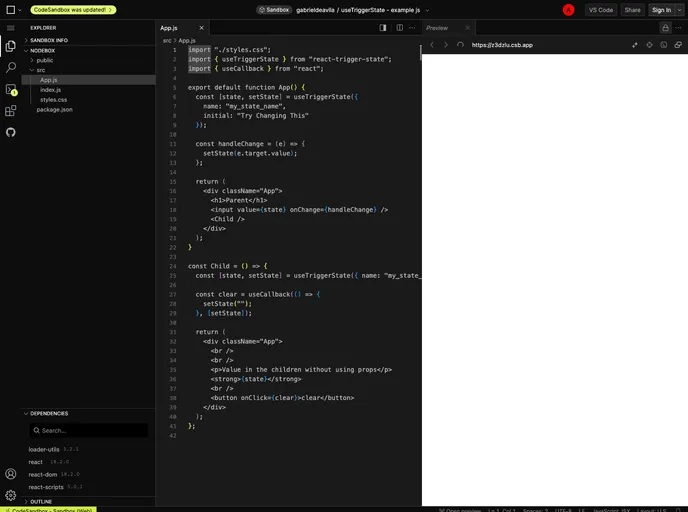


A lightweight state management library for React cross-component communication.
Overview
React Trigger State is a game-changer for developers tired of complicating their code with prop drilling and boilerplate solutions like Redux or Context API. This innovative tool allows you to trigger state changes from anywhere within your application without the tedious hassle, enabling seamless communication between components that do not share a parent-child relationship. Whether you're navigating through pages or dealing with state management in a straightforward way, React Trigger State gives you the agility to manage your app’s state efficiently.
This library simplifies state management, allowing for both global and reactive state handling, ensuring that your components stay updated promptly as changes occur. With an easy setup and intuitive usage, React Trigger State is designed to streamline your development process.
Features
-
useTriggerState Hook: Facilitate state changes from anywhere in your app with this simple hook that behaves like standard state management.
-
GlobalState Component: Access a global state from any part of the application, allowing you to create, delete, and update data efficiently without unnecessary renders.
-
stateStorage Component: A reactive solution that ensures components automatically rerender when state changes, keeping your UI responsive and up to date.
-
Cross-Component Communication: Enable components to communicate without a direct parent-child relationship, making your component structure cleaner and more manageable.
-
Persistent Data Storage: Avoid data loss even when a user navigates away and then returns, thanks to built-in data storage capabilities.
-
Ease of Installation: Quickly integrate React Trigger State into your project with simple installation instructions via NPM or Yarn.
-
Visual Code Examples: Comprehensive documentation with live CodeSandbox examples to facilitate users in getting started and understanding the functionality.
- React
React is a widely used JavaScript library for building user interfaces and single-page applications. It follows a component-based architecture and uses a virtual DOM to efficiently update and render UI components
- SCSS
SCSS is a preprocessor scripting language that extends the capabilities of CSS by adding features such as variables, nesting, and mixins. It allows developers to write more efficient and maintainable CSS code, and helps to streamline the development process by reducing repetition and increasing reusability.
- Eslint

ESLint is a linter for JavaScript that analyzes code to detect and report on potential problems and errors, as well as enforce consistent code style and best practices, helping developers to write cleaner, more maintainable code.
- Rollup

RollupJS is a popular and efficient JavaScript module bundler that takes the code from multiple modules and packages them into a single optimized file, minimizing the overall size of the application and improving its performance.
- Typescript

TypeScript is a superset of JavaScript, providing optional static typing, classes, interfaces, and other features that help developers write more maintainable and scalable code. TypeScript's static typing system can catch errors at compile-time, making it easier to build and maintain large applications.
- Webpack

Webpack is a popular open-source module bundler for JavaScript applications that bundles and optimizes the code and its dependencies for production-ready deployment. It can also be used to transform other types of assets such as CSS, images, and fonts.