
Nextra Blog
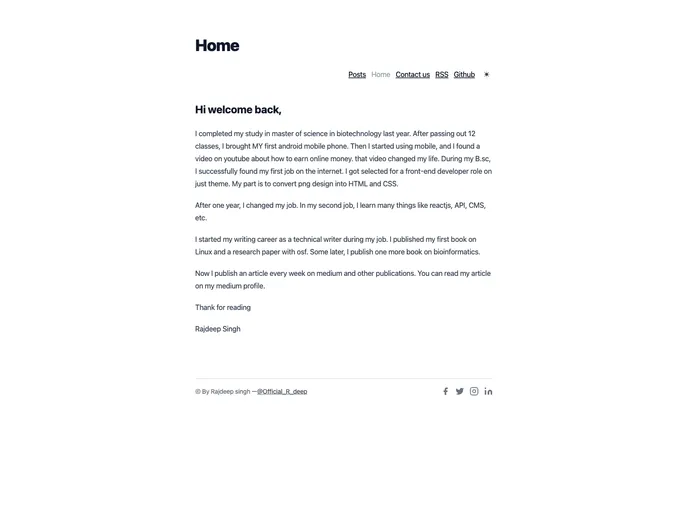


personal Portfolio blog with nextra, nextjs and tailwindcss
Overview:
The Nextra Blog Theme is a portfolio blog that is built with Next.js and Nextra. It offers various features and customization options to create a professional and functional blog.
Features:
- Home page: The theme provides a customizable home page layout to showcase featured content or recent posts.
- Author support: The blog theme includes support for displaying author information on posts and pages.
- Tags support: Users can categorize their posts using tags for better organization and navigation.
- Newsletter support: The theme offers integration with newsletter services, allowing readers to subscribe and receive updates.
- Comment support: Users can enable comments on their blog posts to foster discussion and engagement.
- Syntax (code) highlighting: The theme includes syntax highlighting functionality for code snippets within blog posts.
- Header, post footer, and footer customization: Users can customize the appearance and content of the header, post footer, and footer sections.
- SEO and Sitemap support: The blog theme is built with search engine optimization in mind and has built-in support for generating a sitemap.
Summary:
The Nextra Blog Theme is a Next.js and Nextra-based portfolio blog with various features and customization options. It offers support for author information, tags, comments, newsletters, and syntax highlighting. With its customizable layout and SEO support, it provides a platform for creating a professional and engaging blog. The installation process involves configuring various files to suit personal preferences and content.
- Next.js
Next.js is a React-based web framework that enables server-side rendering, static site generation, and other powerful features for building modern web applications.
- Nextra
Nextra is a Next.js-based static site generator optimized for documentation and blogs. It provides MDX support, automatic sidebar generation, full-text search, and beautiful themes with minimal configuration.
- React
React is a widely used JavaScript library for building user interfaces and single-page applications. It follows a component-based architecture and uses a virtual DOM to efficiently update and render UI components
- Tailwind
Tailwind CSS is a utility-first CSS framework that provides pre-defined classes for building responsive and customizable user interfaces.
- Blog

Blog websites feature posts written by one or more authors, organized by categories and tags, with a section for comments and archives sorted by date or topic. Additional features may include search bar, social media sharing, subscription or RSS feed, about and contact pages, and visual content.
- Eslint

ESLint is a linter for JavaScript that analyzes code to detect and report on potential problems and errors, as well as enforce consistent code style and best practices, helping developers to write cleaner, more maintainable code.
- Postcss

PostCSS is a popular open-source tool that enables web developers to transform CSS styles with JavaScript plugins. It allows for efficient processing of CSS styles, from applying vendor prefixes to improving browser compatibility, ultimately resulting in cleaner, faster, and more maintainable code.