
Banana UI
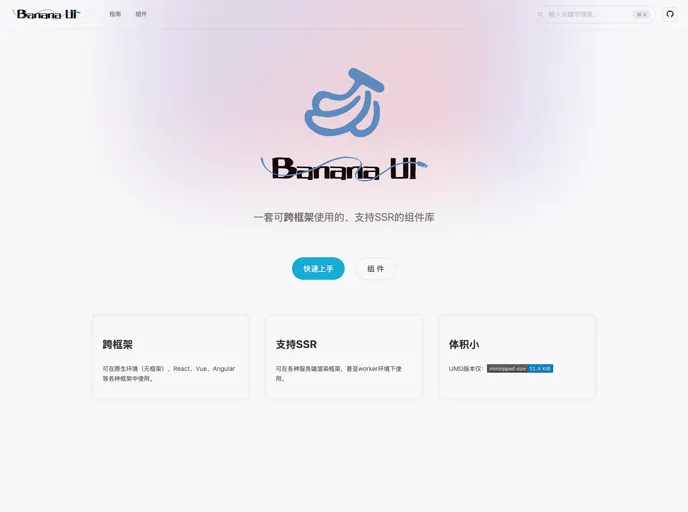

基于Web Components,跨框架可用的现代化组件库。https://banana-ui.com
Overview
Banana UI is an innovative component library built on Web Components, designed to offer commonly used components adaptable for various web frameworks. Its versatility allows developers to integrate it seamlessly into native environments or frameworks like React and Vue, making it an appealing choice for creating consistent UI experiences across multiple projects. With a strong emphasis on server-side rendering (SSR) capabilities, Banana UI positions itself as a robust solution for modern web development needs.
Whether you’re developing a comprehensive plugin or need a reliable toolkit for diverse projects, Banana UI’s flexible architecture caters to a wide range of applications — from e-commerce sites to content management systems. As a relatively new library, it brings fresh capabilities to web developers while still being in early stages of refinement, making engagement and community contributions highly encouraged.
Features
- Framework Agnostic: Compatible with almost any web framework, including React and Vue, as well as in native (no-frame) environments.
- Server-Side Rendering Support: Supports SSR, allowing for optimal performance in environments like workers.
- Excellent TypeScript Integration: Provides strong TypeScript support for better development experience and code quality.
- Cross-Platform Usability: Designed for both PC and mobile platforms, facilitating a wide range of applications.
- Comprehensive Unit Testing: Includes a thorough unit testing framework ensuring reliability and stability of components.
- Community Contributions Welcome: Actively encourages developers to contribute, ask questions, and join in the library’s evolution.
- Early Adoption in Production: Already being used successfully in live projects, with a focus on continuous improvement and user feedback.
- React
React is a widely used JavaScript library for building user interfaces and single-page applications. It follows a component-based architecture and uses a virtual DOM to efficiently update and render UI components
- UI Kits & Components

A UI kit provides developers with a set of reusable components that can be easily integrated into a website or application. These components are pre-designed with consistent styling and functionality, allowing developers to save time and effort in the design and development process. UI kits can be either custom-built or third-party, and often include components for buttons, forms, typography, icons, and more.
- Eslint

ESLint is a linter for JavaScript that analyzes code to detect and report on potential problems and errors, as well as enforce consistent code style and best practices, helping developers to write cleaner, more maintainable code.
- GitHub Pages

Gridsome is a Vue.js-based static site generator that makes it easy to build fast and flexible websites and applications by leveraging modern web technologies like GraphQL, Webpack, and hot reloading
- Rollup

RollupJS is a popular and efficient JavaScript module bundler that takes the code from multiple modules and packages them into a single optimized file, minimizing the overall size of the application and improving its performance.
- Stylelint
Stylelint is a modern linter for CSS that helps you avoid errors and enforce consistent styling conventions. It provides rules for detecting errors and warnings, and can be configured to match your specific project's requirements.
- Typescript

TypeScript is a superset of JavaScript, providing optional static typing, classes, interfaces, and other features that help developers write more maintainable and scalable code. TypeScript's static typing system can catch errors at compile-time, making it easier to build and maintain large applications.
- Web Components

Web components provide a way to create reusable, encapsulated UI components using standard web technologies such as HTML, CSS, and JavaScript. They allow developers to create complex UI components that can be easily shared across multiple projects and frameworks. Web components are built using four main specifications: Custom Elements, Shadow DOM, HTML Templates, and ES Modules.