
Featurevisor
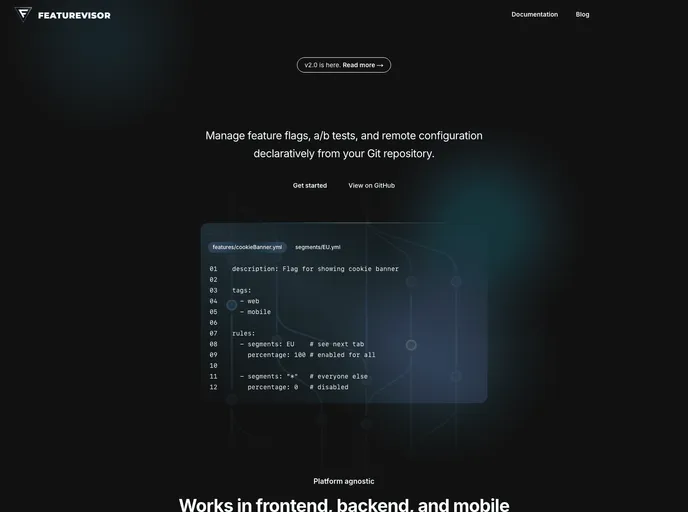


Feature flags, experiments, and remote config management with version control
Overview
Featurevisor is an innovative platform designed to optimize the management of feature flags, experiments, and remote configurations directly through a Git repository. This declarative approach simplifies the development workflow, allowing teams to implement changes efficiently and safely. Users can manage their feature launch strategies with ease, ensuring that development teams can focus more on building quality applications rather than wrestling with complex configurations.
The workflow is straightforward, consisting of three main steps: managing your configurations in Git, triggering CI/CD pipelines to upload datafiles, and fetching those files using Featurevisor SDKs. This functionality provides the flexibility needed to conduct experiments and roll out new features gradually, reducing the risks commonly associated with major releases.
Features
- Feature Flags: Easily create on/off switches for controlling feature availability within your applications.
- Experimentation: Conduct A/B and multivariate tests to assess user engagement and make data-driven decisions.
- Segmentation: Define reusable conditions to target specific user groups effectively.
- Gradual Rollouts: Implement features incrementally to minimize risk by gradually increasing rollout percentage from 0% to 100%.
- Variables: Store key/value pairs for remote configurations, helping you manage settings under different features systematically.
- Consistent Bucketing: Ensure a user receives the same variations across multiple devices and sessions for a seamless experience.
- Multiple Environments: Move beyond just staging and production to accommodate various scenarios within your development cycles.
- Tagging: Load only the features relevant to your application, preventing unnecessary bloat and improving performance.
- React
React is a widely used JavaScript library for building user interfaces and single-page applications. It follows a component-based architecture and uses a virtual DOM to efficiently update and render UI components
- Vue
Vue.js is a lightweight and flexible JavaScript framework that allows developers to easily build dynamic and reactive user interfaces. Its intuitive syntax, modular architecture, and focus on performance make it a popular choice for modern web development.
- Eslint

ESLint is a linter for JavaScript that analyzes code to detect and report on potential problems and errors, as well as enforce consistent code style and best practices, helping developers to write cleaner, more maintainable code.
- Typescript

TypeScript is a superset of JavaScript, providing optional static typing, classes, interfaces, and other features that help developers write more maintainable and scalable code. TypeScript's static typing system can catch errors at compile-time, making it easier to build and maintain large applications.
- Webpack

Webpack is a popular open-source module bundler for JavaScript applications that bundles and optimizes the code and its dependencies for production-ready deployment. It can also be used to transform other types of assets such as CSS, images, and fonts.