
Proppy
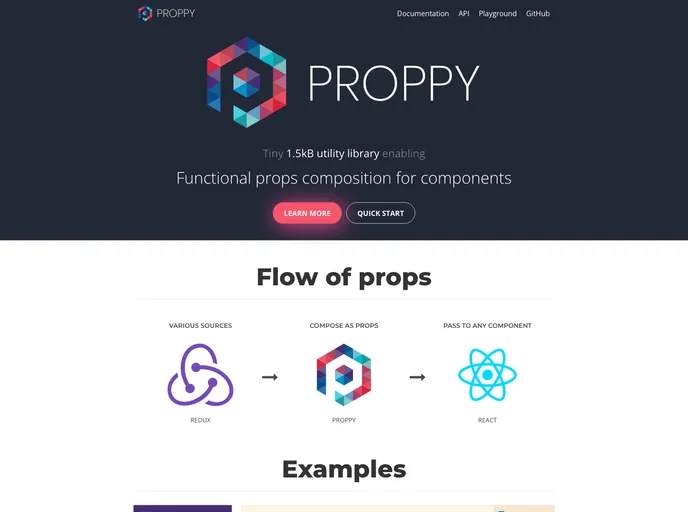





Functional props composition for UI components (React.js & Vue.js)
Overview
ProppyJS is a lightweight JavaScript library designed for composing props that components use to render themselves. Weighing in at just 1.5kB, its small footprint makes it ideal for developers aiming to keep their applications efficient and streamlined. The library offers a variety of integration packages, ensuring it can easily connect to popular rendering libraries like React, Vue.js, and Preact, making it a versatile choice for front-end development.
The core philosophy behind ProppyJS is to express component behavior as props, which simplifies the process of connecting these props to the intended components. This allows for a more organized and maintainable code structure while giving developers access to essential dependencies throughout the component tree, enhancing overall workflow and productivity.
Features
- Lightweight Design: At only 1.5kB, ProppyJS ensures minimal impact on bundle size while providing powerful prop composition capabilities.
- Multiple Integrations: Offers dedicated packages for React, Vue.js, Preact, and even Redux and RxJS, allowing seamless integration with popular libraries.
- Dynamic Props Support: Easily manage interactive props using functions like
withState, enabling your components to react and update in real-time. - Composition Functionality: The
composefunction lets you consolidate multiple factories into a single instance, streamlining prop management. - Application-Wide Providers: Access shared dependencies across all Proppy instances, ideal for applications that require centralized state management.
- Simple API: With familiar and straightforward APIs, developers can quickly learn and implement ProppyJS in their projects, reducing onboarding time.
- Single Subscription Model: Efficiently handles prop updates with a subscription model that emits new values only when necessary, keeping performance optimized.
- Metalsmith
Metalsmith is a flexible and modular Static Site Generator (SSG) built on Node.js. It operates on a simple plugin-based architecture, allowing developers to easily customize and transform content to generate static websites with diverse functionalities.
- React
React is a widely used JavaScript library for building user interfaces and single-page applications. It follows a component-based architecture and uses a virtual DOM to efficiently update and render UI components
- Vue
Vue.js is a lightweight and flexible JavaScript framework that allows developers to easily build dynamic and reactive user interfaces. Its intuitive syntax, modular architecture, and focus on performance make it a popular choice for modern web development.
- Bulma
Bulma is a free, open source CSS framework based on Flexbox and built with Sass. It's 100% responsive, fully modular, and available for free.
- SCSS
SCSS is a preprocessor scripting language that extends the capabilities of CSS by adding features such as variables, nesting, and mixins. It allows developers to write more efficient and maintainable CSS code, and helps to streamline the development process by reducing repetition and increasing reusability.
- Redux
Redux is a state management library for JavaScript apps that provides a predictable and centralized way to manage application state. It enables developers to write actions and reducers that update the state in response to user interactions, server responses, and other events, and can be used with a variety of front-end frameworks and back-end technologies.
- Typescript

TypeScript is a superset of JavaScript, providing optional static typing, classes, interfaces, and other features that help developers write more maintainable and scalable code. TypeScript's static typing system can catch errors at compile-time, making it easier to build and maintain large applications.
- Webpack

Webpack is a popular open-source module bundler for JavaScript applications that bundles and optimizes the code and its dependencies for production-ready deployment. It can also be used to transform other types of assets such as CSS, images, and fonts.