
Python Dependency Injector
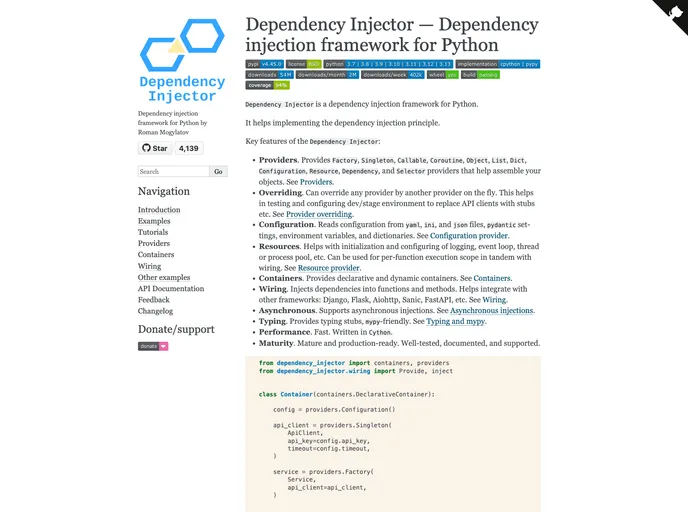

Dependency injection framework for Python
Overview
Python Dependency Injector is a powerful framework designed to streamline the process of dependency injection in Python applications. By managing the relationships between objects and their dependencies, it helps developers create cleaner, more maintainable code that adheres to best practices. Whether you're building small projects or large-scale applications, this library offers the flexibility and functionality needed to simplify dependency management.
One of the key benefits of using Python Dependency Injector is its ability to increase code testability and reduce coupling between components. As applications grow in complexity, utilizing a dependency injection framework can prevent the hassle of manually managing dependencies, making it easier for teams to collaborate and maintain consistency throughout the development lifecycle.
Features
- Ease of Use: Simple and intuitive API allows for quick integration into existing projects without steep learning curves.
- Type Safety: Leverages Python's type hints for better reliability and improved debugging, ensuring dependencies are accurately resolved.
- Scoped Instances: Supports different scopes like singleton and transient, allowing for flexible management of object lifetimes and states.
- Factory Support: Define factories for creating instances, which streamline the creation process and enhance code reusability.
- Configuration Management: Offers a centralized method for configuring dependencies, making it easier to manage changes across applications.
- Built-in Providers: Includes a variety of built-in providers for common types of dependencies, reducing the need for boilerplate code.
- Testing Compatibility: With support for mock objects, it significantly simplifies the testing of components in isolation without the need for their actual dependencies.
- Flask
Flask is a lightweight and popular web framework for Python, known for its simplicity and flexibility. It is widely used to build web applications, providing a minimalistic approach to web development with features like routing, templates, and support for extensions.