
Design Patterns
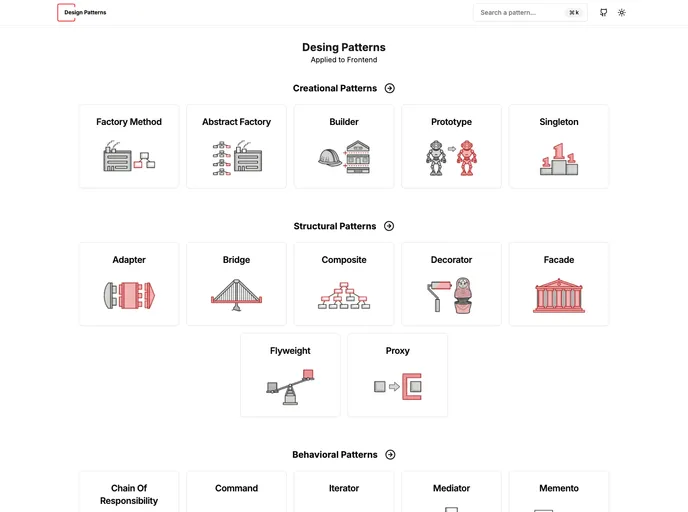



Design patterns applied to Frontend development, build with Next.js 13
Overview
Frontend development continuously evolves, and incorporating design patterns can significantly enhance the quality and maintainability of your code. This exploration of design patterns applied to Frontend focuses on their ability to offer structured solutions to common development problems, ensuring that developers can create cleaner, more efficient applications. Understanding these patterns not only streamlines code organization but also fosters reusability and better collaboration within teams.
By leveraging these proven methodologies, developers can tackle challenges ranging from building adaptable UI components to managing complex application states. This resource serves as a guide to help you understand the practical applications of various design patterns, ultimately leading to more robust and maintainable Frontend architecture.
Features
- Flexible UI Components: Design patterns facilitate the creation of customizable UI components that can adapt to various user needs and designs.
- State Management: They provide effective solutions for managing complex workflows and state transitions, improving the overall user experience.
- API Integration: Patterns assist in adapting external libraries or APIs, allowing for more seamless integration with different interfaces.
- Dynamic Interactions: Implementing these patterns helps in creating dynamic behaviors based on user interactions, enhancing user engagement.
- Separation of Concerns: They encourage code modularity, ensuring that distinct functionalities are encapsulated, leading to easier maintenance.
- Performance Optimization: Design patterns can be integral in optimizing resource usage, enhancing the performance of the application.
- Coding Standards: They promote consistent coding standards and best practices within development teams, standardizing quality across the project.
- Next.js
Next.js is a React-based web framework that enables server-side rendering, static site generation, and other powerful features for building modern web applications.
- React
React is a widely used JavaScript library for building user interfaces and single-page applications. It follows a component-based architecture and uses a virtual DOM to efficiently update and render UI components
- Tailwind
Tailwind CSS is a utility-first CSS framework that provides pre-defined classes for building responsive and customizable user interfaces.
- cmdk
cmdk is a fast, composable command menu component for React. It provides the foundation for building command palettes, search interfaces, and keyboard-navigable menus similar to those found in applications like VS Code, Linear, and Raycast.
- Radix UI
Radix Primitives is a low-level UI component library with a focus on accessibility, customization and developer experience. You can use these components either as the base layer of your design system, or adopt them incrementally.
- Shadcn UI
Beautifully designed components that you can copy and paste into your apps. Accessible. Customizable. Open Source.
- Contentlayer

Contentlayer is an open-source platform for building dynamic, data-driven websites and applications using markdown files as the content source. It features an intuitive API, flexible content modeling, and easy integration with popular frontend frameworks and tools.
- Eslint

ESLint is a linter for JavaScript that analyzes code to detect and report on potential problems and errors, as well as enforce consistent code style and best practices, helping developers to write cleaner, more maintainable code.
- MDX

MDX is a format that allows developers to write JSX within Markdown documents, combining the power of React with the simplicity of Markdown. This allows for the creation of dynamic and interactive content that can be easily shared and consumed across different platforms and devices.
- Postcss

PostCSS is a popular open-source tool that enables web developers to transform CSS styles with JavaScript plugins. It allows for efficient processing of CSS styles, from applying vendor prefixes to improving browser compatibility, ultimately resulting in cleaner, faster, and more maintainable code.
- Typescript

TypeScript is a superset of JavaScript, providing optional static typing, classes, interfaces, and other features that help developers write more maintainable and scalable code. TypeScript's static typing system can catch errors at compile-time, making it easier to build and maintain large applications.