
Rsc Examples
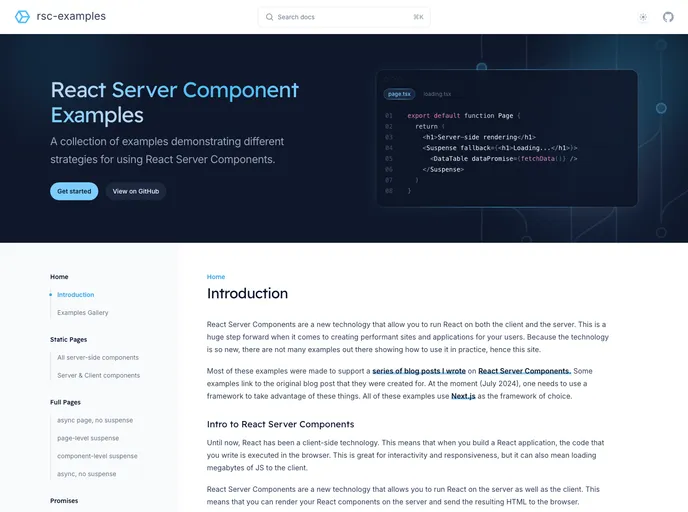


A collection of examples of how to use React Server Components, using Next JS
Overview
This collection of React Server Component examples offers an invaluable resource for developers looking to delve deeper into the capabilities of React. Designed to accompany a series of informative blog posts, the examples are readily accessible and can be run locally, providing a hands-on approach to learning. Each example is structured to ensure that users can easily navigate and understand the functionality being demonstrated, making it a great tool for both beginners and seasoned developers.
With a well-organized directory and clear instructions, these examples serve as an excellent starting point for anyone interested in mastering React Server Components. Whether you choose to explore them online or prefer to run them locally, the comprehensive nature of these examples is sure to enhance your development experience.
Features
-
MDX Rendering: Utilizes
<MDXRemote>to effectively render README.mdx files, showcasing content with rich formatting and structure. -
Structured Examples: Each example resides in the
src/app/examplesfolder and includes a README.mdx file, ensuring that all necessary documentation is readily available. -
Frontmatter Declaration: The README.mdx files must include a frontmatter section with a title and slug, allowing for seamless navigation and organization mirroring the file structure.
-
Video Recording: Run
npm run videoto automatically generate timestamped videos for examples lacking visual documentation in the public/videos directory. -
Related Examples Generation: Implements ReadNext to suggest related examples at the bottom of each page, enhancing the learning experience by connecting similar concepts.
-
Customization Options: Offers the ability to disable video looping for enhanced user control during video playback.
-
Search Functionality: Continuously being improved to enhance finding specific examples or topics within the collection.
- Next.js
Next.js is a React-based web framework that enables server-side rendering, static site generation, and other powerful features for building modern web applications.
- React
React is a widely used JavaScript library for building user interfaces and single-page applications. It follows a component-based architecture and uses a virtual DOM to efficiently update and render UI components
- Tailwind
Tailwind CSS is a utility-first CSS framework that provides pre-defined classes for building responsive and customizable user interfaces.
- Headless UI
Headless UI is a set of completely unstyled, fully accessible UI components for React, Vue, and Alpine.js that empower developers to build their own fully accessible custom UI components. Headless UI allows developers to focus on building accessible and highly functional user interfaces, without the need to worry about styling or layout.
- Eslint

ESLint is a linter for JavaScript that analyzes code to detect and report on potential problems and errors, as well as enforce consistent code style and best practices, helping developers to write cleaner, more maintainable code.
- MDX

MDX is a format that allows developers to write JSX within Markdown documents, combining the power of React with the simplicity of Markdown. This allows for the creation of dynamic and interactive content that can be easily shared and consumed across different platforms and devices.
- Typescript

TypeScript is a superset of JavaScript, providing optional static typing, classes, interfaces, and other features that help developers write more maintainable and scalable code. TypeScript's static typing system can catch errors at compile-time, making it easier to build and maintain large applications.
- Zod

Zod is a TypeScript-first schema declaration and validation library. It allows you to define schemas that can validate data at runtime while providing excellent TypeScript inference, making it perfect for API validation, form validation, and type-safe data handling.