
Nextjs Gel Auth Template
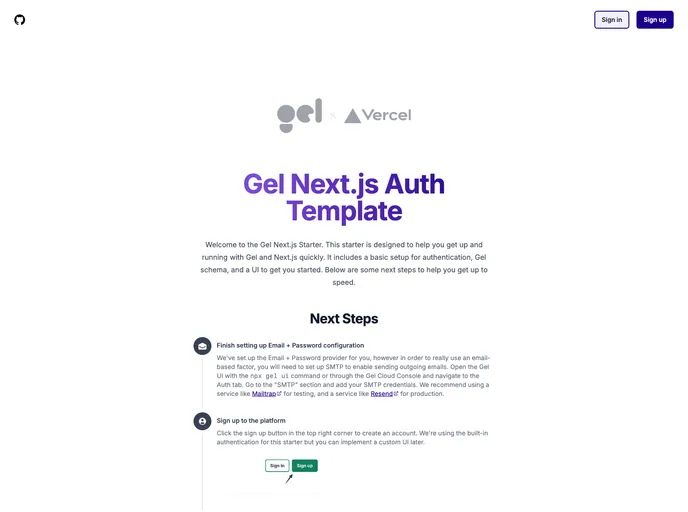


A minimal starter designed to help you get up and running with Gel and Next.js quickly. It includes a basic setup for authentication, Gel schema, and a UI to get you started.
Overview
The Next.js + EdgeDB + EdgeDB Auth template is a streamlined starter kit designed for developers wanting to quickly set up modern web applications using EdgeDB as a database and Next.js as the front-end framework. This template simplifies the initial setup process by integrating essential features such as authentication and a structured directory for easy navigation. With built-in utilities and clear guidance, it's an excellent choice for both new and experienced developers aiming to accelerate their workflow.
By utilizing this template, you not only tap into Next.js's powerful React framework but also leverage EdgeDB's robust database capabilities. The combination ensures that you can swiftly develop and deploy applications, allowing you to focus on building features rather than getting bogged down by configuration.
Features
- Next.js Framework: Built on Next.js, offering superior performance and an easy-to-use React environment.
- EdgeDB Database: Comes pre-configured with EdgeDB, providing a modern and efficient database solution for your applications.
- EdgeDB Auth Integration: Includes scripts for implementing secure authentication, defaulting to email and password sign-in for ease of use.
- Tailwind CSS: Utilizes Tailwind CSS for a utility-first styling approach, making it simple to create visually appealing interfaces quickly.
- ESLint Support: Pre-configured with ESLint to help you maintain code quality and adhere to best practices.
- Structured Directory Layout: Organizes components, assets, and schema in a clear structure, simplifying navigation and development.
- TypeScript Support: Generates TypeScript types from your EdgeDB schema, enhancing type safety and developer experience.
- Deployment Ready: Set up with minimal configuration required to launch your application, thanks to included scripts and instructions.
- Next.js
Next.js is a React-based web framework that enables server-side rendering, static site generation, and other powerful features for building modern web applications.
- React
React is a widely used JavaScript library for building user interfaces and single-page applications. It follows a component-based architecture and uses a virtual DOM to efficiently update and render UI components
- Tailwind
Tailwind CSS is a utility-first CSS framework that provides pre-defined classes for building responsive and customizable user interfaces.
- Headless UI
Headless UI is a set of completely unstyled, fully accessible UI components for React, Vue, and Alpine.js that empower developers to build their own fully accessible custom UI components. Headless UI allows developers to focus on building accessible and highly functional user interfaces, without the need to worry about styling or layout.
- Templates & Themes

A template or theme refers to a pre-designed layout or structure that provides a basic framework for building a specific type of application or website. It typically includes good design, placeholder content and functional features, allowing developers to customize and fill in the details according to their specific needs.
- Eslint

ESLint is a linter for JavaScript that analyzes code to detect and report on potential problems and errors, as well as enforce consistent code style and best practices, helping developers to write cleaner, more maintainable code.
- Postcss

PostCSS is a popular open-source tool that enables web developers to transform CSS styles with JavaScript plugins. It allows for efficient processing of CSS styles, from applying vendor prefixes to improving browser compatibility, ultimately resulting in cleaner, faster, and more maintainable code.
- Typescript

TypeScript is a superset of JavaScript, providing optional static typing, classes, interfaces, and other features that help developers write more maintainable and scalable code. TypeScript's static typing system can catch errors at compile-time, making it easier to build and maintain large applications.