
DID Django
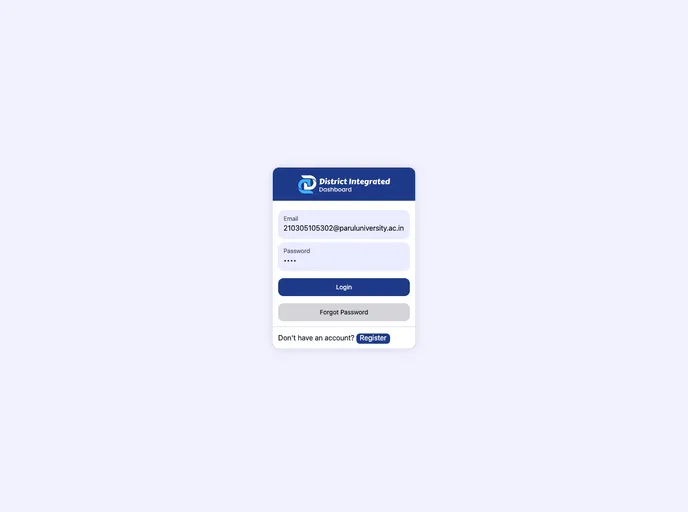






District Integrated Dashboard: A web-based application for visualizing and analyzing district-level data, featuring real-time analytics, user role management, and data import/export capabilities for informed decision-making.
Overview
The District Integration Dashboard is an innovative web application meticulously crafted to streamline the management and visualization of district-level data. With its elegant interface built on React and powered by Django on the backend, this platform caters to the peculiar needs of administrative and government sectors, making it a pivotal tool for effective governance. The dashboard encompasses a variety of functionalities, enabling users to manage population data, track schemes, and aggregate city data effortlessly.
This comprehensive solution promises a robust user experience, emphasizing security and real-time updates. As governments and district authorities seek efficient ways to make data-driven decisions, the District Integration Dashboard stands out as a reliable resource that merges technology with public service needs.
Features
-
District Data Visualization: Interactively visualize critical data such as demographic statistics, public service availability, and district schemes, ensuring an engaging user experience through React.
-
Data Management & Analytics: Efficiently manage essential data points for cities and talukas, complete with visual representations in charts and tables for faster decision-making.
-
Secure Authentication: Users can trust the security of their data with token-based authentication utilizing JWT, safeguarding access to sensitive information.
-
User Roles & Permissions: Customized user authentication allows for precise role management, granting varied access levels to ensure only authorized personnel view confidential data.
-
RESTful API: The backend employs Django Rest Framework (DRF), providing a seamless way to access and modify data with standard HTTP requests.
-
SQLite Database: The lightweight SQLite database ensures quick access and management of user data, population metrics, and scheme details.
-
Real-time Data Updates: The dashboard guarantees that users have immediate access to the latest city and scheme data, keeping them informed at all times.
-
State-of-the-art Frontend Technologies: Utilizing React, JavaScript, and Tailwind CSS, the dashboard delivers a fast, dynamic user experience while ensuring a visually appealing and responsive design across devices.
- Django
Django is a high-level Python web framework that encourages rapid development and clean, pragmatic design. It follows the model-view-controller (MVC) architectural pattern, providing an extensive set of built-in tools and conventions to streamline the creation of robust and scalable web applications.
- HTML
HTML templates are pre-designed and pre-built web pages that can be customized and used as a basis for building websites. They often include common elements such as headers, footers, menus, and content sections, and can be easily edited using HTML and CSS to fit specific branding and content needs.
- Next.js
Next.js is a React-based web framework that enables server-side rendering, static site generation, and other powerful features for building modern web applications.
- React
React is a widely used JavaScript library for building user interfaces and single-page applications. It follows a component-based architecture and uses a virtual DOM to efficiently update and render UI components
- Vite
Vite is a build tool that aims to provide a faster and leaner development experience for modern web projects
- Tailwind
Tailwind CSS is a utility-first CSS framework that provides pre-defined classes for building responsive and customizable user interfaces.
- Material UI
material-ui adds classes to Tailwind CSS for all common UI components. Classes like btn, card, etc. This allows us to focus on important things instead of making basic elements for every project.