
Django Webtest
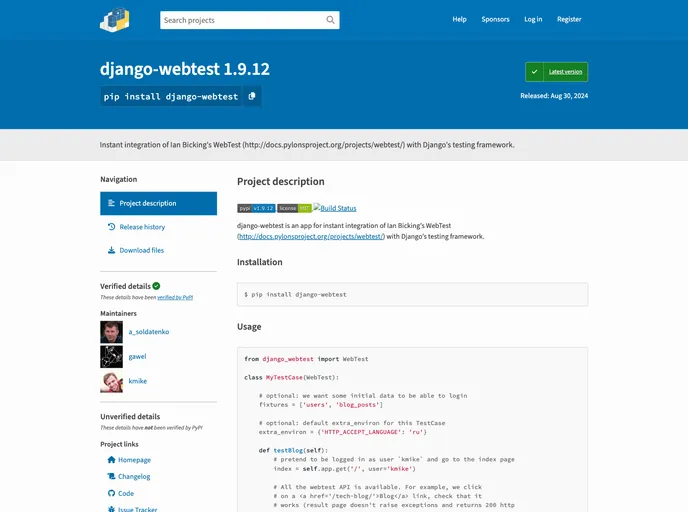
django-webtest provides integration of Ian Bicking's WebTest (http://docs.pylonsproject.org/projects/webtest/) with django's testing framework.
Overview
Django Webtest seamlessly integrates Ian Bicking's WebTest with Django's testing framework, enhancing the ability to perform functional testing in Django applications. By leveraging the powerful features of WebTest, developers can create and execute tests that simulate user interactions on web applications, ensuring that everything behaves as expected before going live.
This tool simplifies the setup process and provides a more intuitive way to work with testing in Django, making it an invaluable asset for developers looking to guarantee the reliability and stability of their applications. With Django Webtest, you can focus on building great features while having the confidence that your testing suite is robust and effective.
Features
-
Integration with Django: Works effortlessly within Django’s testing framework, allowing you to use familiar tools and practices.
-
User Interaction Simulation: Enables testing of user actions like clicking links, filling forms, and submitting data, closely mimicking real user behavior.
-
Easy Setup: Quick and straightforward installation process that gets you up and running with minimal configuration.
-
Comprehensive Assertions: Provides a wide range of assertions to verify the state of the application, such as checking for specific text or the presence of HTML elements.
-
Advanced Request Handling: Allows for complex HTTP request simulation, such as handling cookies and headers, making it ideal for realistic testing scenarios.
-
Integration with Continuous Integration (CI) Tools: Easily integrates into CI pipelines, ensuring that tests are run automatically with your code changes.
-
Support for Multiple Browsers: While primarily focused on testing within Django, it can be configured to simulate different browser behaviors for compatibility testing.