
Django Components
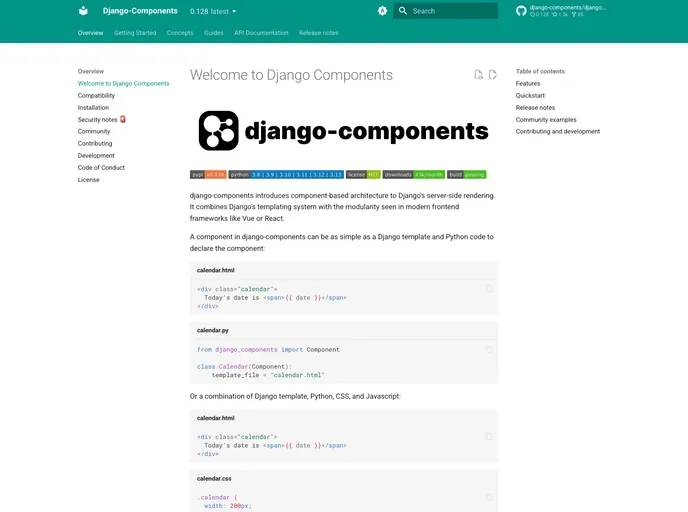

Create simple reusable template components in Django.
Overview
Django-components is a package that brings component-based architecture to Django's server-side rendering, combining Django's templating system with the modularity of modern frontend frameworks. It allows for the creation of reusable UI elements, encapsulates HTML, CSS, and JavaScript within each component, and enables server-side rendering for improved load times and SEO. This package simplifies the management of complex UIs, reduces code duplication, and enhances collaboration between frontend and backend developers within the Django ecosystem.
Features
- Reusability: Create self-contained, reusable UI elements.
- Encapsulation: Components include their own HTML, CSS, and JavaScript.
- Server-side rendering: Components render on the server for faster load times and better SEO.
- Django integration: Works seamlessly with Django using familiar concepts like template tags.
- Asynchronous loading: Components can render independently, allowing integration with JS frameworks like HTMX or AlpineJS.
Summary
Django-components is a valuable package for Django projects seeking to introduce a more structured approach to UI development without needing to adopt a separate frontend framework. By enabling the creation of reusable components and server-side rendering, django-components enhances code reusability, maintainability, and collaboration between frontend and backend developers. The provided documentation, release notes, and community examples offer further support for implementing and sharing components effectively within Django projects.
- Django
Django is a high-level Python web framework that encourages rapid development and clean, pragmatic design. It follows the model-view-controller (MVC) architectural pattern, providing an extensive set of built-in tools and conventions to streamline the creation of robust and scalable web applications.