
Nextjs Twitter Starter
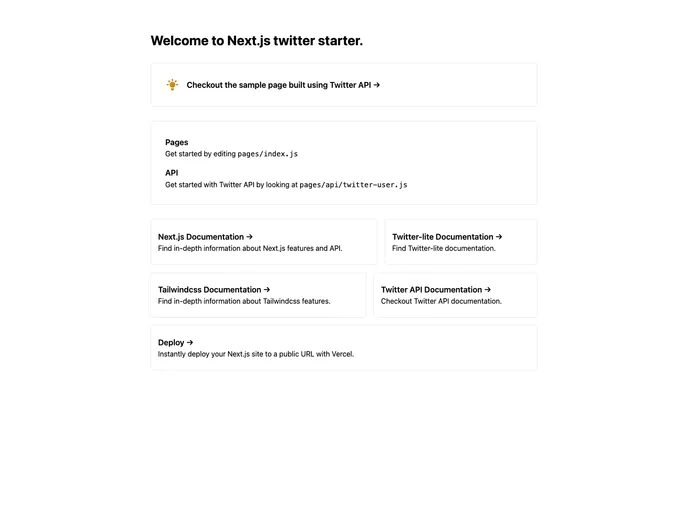


A starter kit for building apps using Twitter API with Next.js
Overview
The Next.js Twitter starter kit is a web development tool that provides a foundation for building Twitter applications using the Next.js framework. It comes with pre-installed packages like Next.js, Tailwindcss, and Twitter-lite, and offers both app and user authentication options. This starter kit aims to simplify the process of creating and deploying Twitter apps by providing a straightforward setup process and sample API routes.
Features
- Next.js: Utilizes the Next.js framework for efficient server-side rendering and routing.
- Tailwindcss: Incorporates the Tailwindcss utility-first CSS framework for easy and responsive styling.
- Twitter-lite: Includes the Twitter-lite package for simplified access to the Twitter API.
- App and User Authentication: Provides both app and user authentication options, with app authentication offering higher rate limits and user authentication offering lower rate limits.
- Sample API Routes: Includes a sample API route for retrieving Twitter user information, with the ability to make POST requests using Postman and specify the content type as JSON.
- Example Page: Includes an example page that displays a Twitter card with a Twitter user's information.
Summary
The Next.js Twitter starter kit provides a convenient starting point for building Twitter applications using Next.js. With built-in packages like Next.js, Tailwindcss, and Twitter-lite, developers can quickly set up the application and start building feature-rich Twitter apps. The kit supports both app and user authentication methods, and includes sample API routes and an example page to help developers understand and customize the functionality. Deployment options are also available through the Vercel Platform, making it easy to deploy the app and share it with others.
- Next.js
Next.js is a React-based web framework that enables server-side rendering, static site generation, and other powerful features for building modern web applications.
- React
React is a widely used JavaScript library for building user interfaces and single-page applications. It follows a component-based architecture and uses a virtual DOM to efficiently update and render UI components
- Tailwind
Tailwind CSS is a utility-first CSS framework that provides pre-defined classes for building responsive and customizable user interfaces.
- Eslint

ESLint is a linter for JavaScript that analyzes code to detect and report on potential problems and errors, as well as enforce consistent code style and best practices, helping developers to write cleaner, more maintainable code.
- Postcss

PostCSS is a popular open-source tool that enables web developers to transform CSS styles with JavaScript plugins. It allows for efficient processing of CSS styles, from applying vendor prefixes to improving browser compatibility, ultimately resulting in cleaner, faster, and more maintainable code.