
Md2
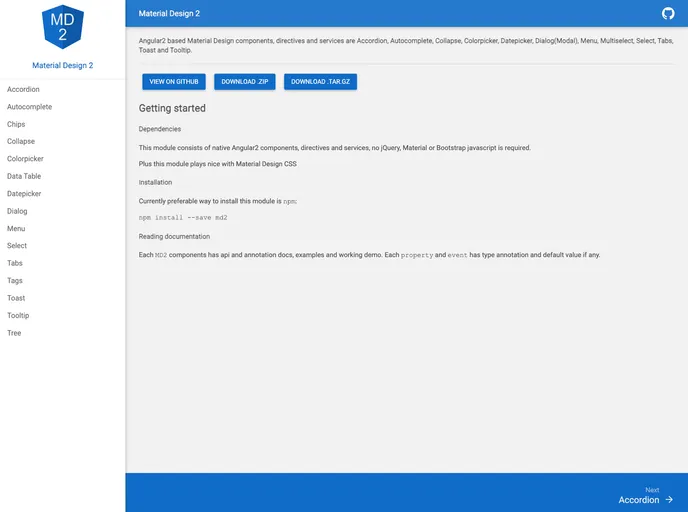


[We have moved our Repository on https://github.com/promact/md2 please refer it for latest implementation.] Angular2 based Material Design components, directives and services are Accordion, Autocomplete, Collapse, Colorpicker, Datepicker, Dialog(Modal), Menu, Multiselect, Select, Switch, Tabs, T...
Overview
MD2 is a collection of Angular 2-based Material Design components that facilitate the creation of modern, user-friendly interfaces. Designed with a focus on high-quality standards, this suite of components encompasses various essential UI elements that follow the Material Design specifications. By relying on Angular and TypeScript, MD2 aims to provide developers with reliable tools that empower them to build applications efficiently while maintaining accessibility and usability for end-users.
The goal of MD2 is not only to provide a robust library of components but also to exemplify best practices in Angular development. With a commitment to internationalization, performance, and clarity, MD2 is tailored for both seasoned developers and those new to the Angular ecosystem.
Features
-
Wide Range of Components: Includes essential UI elements such as Accordion, Autocomplete, Datepicker, and Dialog, ensuring a comprehensive toolkit for developers.
-
Accessibility Focused: Components are designed to be accessible to all users, supporting various screen readers and adhering to internationalization standards.
-
Straightforward APIs: The APIs are crafted to be easy to understand, minimizing confusion for developers and promoting a smoother integration process.
-
High Performance: Built with performance in mind, MD2 components ensure minimal impact on application load times and responsiveness.
-
Customizable Design: Components can be tailored within the constraints of the Material Design framework, allowing for a unique yet compliant user experience.
-
Well-Documented Code: The library features clean and well-structured documentation, serving both as a guide for implementation and a reference for best coding practices.
-
Thorough Testing: Each component is rigorously tested with unit and integration tests to ensure reliability and robust behavior across various use cases.
-
Cross-Browser Support: Compatible with the latest versions of major browsers including Chrome, Firefox, Safari, and Internet Explorer, providing a seamless user experience across platforms.
- Angular
Angular is a TypeScript-based open-source framework by Google for building dynamic single-page applications and cross-platform mobile apps with MVC architecture and a rich set of features.
- SCSS
SCSS is a preprocessor scripting language that extends the capabilities of CSS by adding features such as variables, nesting, and mixins. It allows developers to write more efficient and maintainable CSS code, and helps to streamline the development process by reducing repetition and increasing reusability.
- Gulp

Gulp.js is an old but popular site building tool that automates various repetitive development tasks in web development, such as compiling Sass, minifying JavaScript, and optimizing images.
- Material Design

Material Design is a design system developed by Google that provides a set of guidelines, components, and tools for creating visually appealing and functional user interfaces. Material Design is designed to be flexible and customizable, making it a great choice for a wide range of applications and use cases.
- Rollup

RollupJS is a popular and efficient JavaScript module bundler that takes the code from multiple modules and packages them into a single optimized file, minimizing the overall size of the application and improving its performance.
- Stylelint
Stylelint is a modern linter for CSS that helps you avoid errors and enforce consistent styling conventions. It provides rules for detecting errors and warnings, and can be configured to match your specific project's requirements.
- Typescript

TypeScript is a superset of JavaScript, providing optional static typing, classes, interfaces, and other features that help developers write more maintainable and scalable code. TypeScript's static typing system can catch errors at compile-time, making it easier to build and maintain large applications.