
React Native Expo Starter Kit
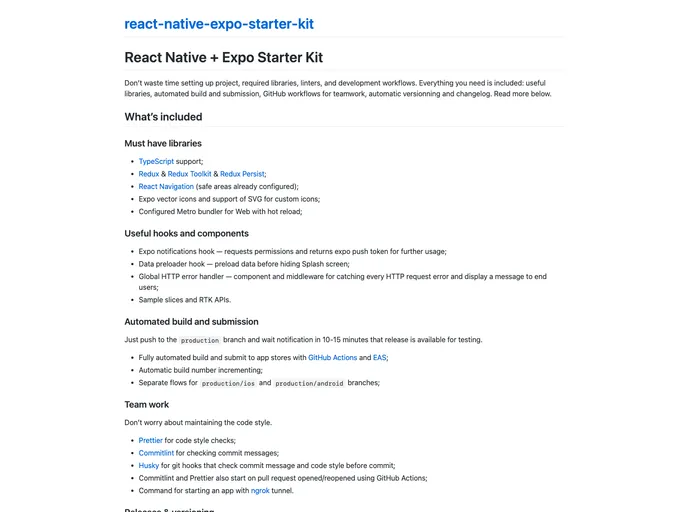


Everything you need for effective react native development: automated build and submissions, must have libraries, automated versioning, code quality tools and more.
Overview
The React Native Expo Starter Kit is an all-in-one solution for developers looking to streamline their React Native projects. This kit simplifies the development process by providing essential tools and libraries that enhance productivity and ensure high-quality code. With features such as automated builds, easy library integration, and more, it addresses the common challenges developers face when starting a new project.
Whether you're a seasoned developer or just getting started with React Native, this starter kit is designed to save you time and reduce complexity. By incorporating best practices and automation, it allows you to focus on creating great user experiences rather than dealing with the intricacies of setup.
Features
- Automated Builds and Submissions: Easily manage your builds and submissions to app stores, eliminating manual errors and saving time.
- Essential Libraries: Includes must-have libraries that are crucial for building modern applications, ensuring that you have the best tools at your fingertips.
- Automated Versioning: Streamline your version control with automated versioning, helping you keep track of updates and releases effortlessly.
- Code Quality Tools: Integrated tools for code quality and linting that help maintain clean and efficient code throughout your development cycle.
- Comprehensive Documentation: Well-organized documentation that guides you through installation and setup, making the onboarding process faster and more intuitive.
- Community Support: Benefit from a vibrant community that provides support and resources, making it easier to troubleshoot issues and share experiences.
- Customizable Templates: Access to customizable templates so that you can quickly kick-start your projects with a predefined structure that suits your needs.
- React
React is a widely used JavaScript library for building user interfaces and single-page applications. It follows a component-based architecture and uses a virtual DOM to efficiently update and render UI components
- React Native
React Native is a framework for building mobile applications using React and JavaScript. It enables developers to write once and deploy to multiple platforms, including iOS, Android, and the web, while providing a native app-like experience to users.
- Expo
An open-source platform for making universal native apps with React. Expo runs on Android, iOS, and the web.
- Redux
Redux is a state management library for JavaScript apps that provides a predictable and centralized way to manage application state. It enables developers to write actions and reducers that update the state in response to user interactions, server responses, and other events, and can be used with a variety of front-end frameworks and back-end technologies.
- Typescript

TypeScript is a superset of JavaScript, providing optional static typing, classes, interfaces, and other features that help developers write more maintainable and scalable code. TypeScript's static typing system can catch errors at compile-time, making it easier to build and maintain large applications.