
V Network Graph
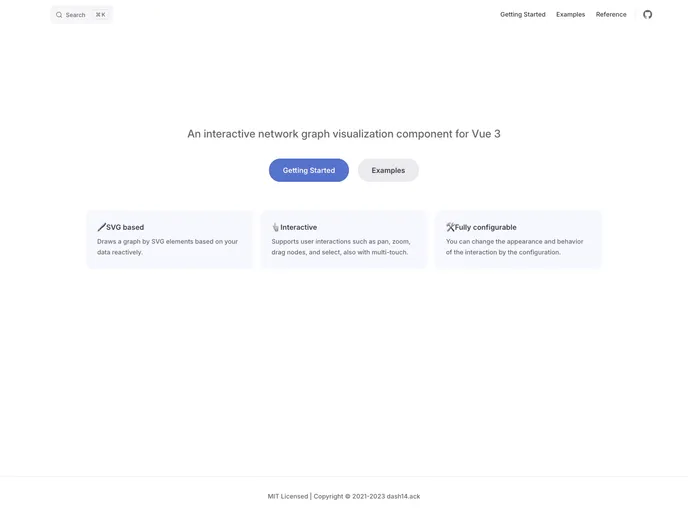


An interactive network graph visualization component for Vue 3
Overview
The v-network-graph is an impressive interactive visualization component designed specifically for Vue 3 applications. It leverages SVG technology to create dynamic and responsive network graph visualizations that can help developers visualize complex data structures interactively. By integrating seamlessly with Vue's reactive programming model, it allows for real-time updates as data changes, offering a user-friendly way to manage and visualize relationships between data points without getting bogged down by complex integrations.
Whether you're building an application that requires intricate visual representations of relationships or just need a straightforward way to display connected data, v-network-graph provides flexibility and customization options that cater to various needs. With this component, developers can focus more on enhancing their applications while relying on a robust tool that simplifies graph visualization.
Features
-
Reactive Data Handling: Automatically updates graphs based on changes to the underlying data, making it easy to visualize real-time data flows.
-
Fully Configurable Appearance: Customize the look and feel of your graphs with a wide range of options for nodes and edges, ensuring they fit your application's style.
-
Pan and Zoom Viewport: Users can easily navigate complex graphs by panning and zooming, resulting in an intuitive use experience.
-
Drag Nodes Functionality: Allows users to click and drag nodes for easier manual adjustment of node positions, facilitating dynamic visualizations.
-
Multi-Touch Support: Designed to work on touch-enabled devices, allowing for gestures to manipulate the graph on mobile devices.
-
Multiple Node and Edge Selection: Efficiently select multiple nodes and edges to perform batch actions, saving time during data manipulation.
-
Various Event Handling: Supports a range of events for interactive features, enabling developers to build responsive user interfaces.
-
Export as SVG: Easily export your visualizations as SVG files for use in other applications or for sharing purposes.
With these features, v-network-graph stands out as a powerful tool for developers looking to incorporate network graphs into their Vue 3 projects effortlessly.
- Vite
Vite is a build tool that aims to provide a faster and leaner development experience for modern web projects
- SCSS
SCSS is a preprocessor scripting language that extends the capabilities of CSS by adding features such as variables, nesting, and mixins. It allows developers to write more efficient and maintainable CSS code, and helps to streamline the development process by reducing repetition and increasing reusability.
- Eslint

ESLint is a linter for JavaScript that analyzes code to detect and report on potential problems and errors, as well as enforce consistent code style and best practices, helping developers to write cleaner, more maintainable code.
- Typescript

TypeScript is a superset of JavaScript, providing optional static typing, classes, interfaces, and other features that help developers write more maintainable and scalable code. TypeScript's static typing system can catch errors at compile-time, making it easier to build and maintain large applications.