
Dagpi Dashboard
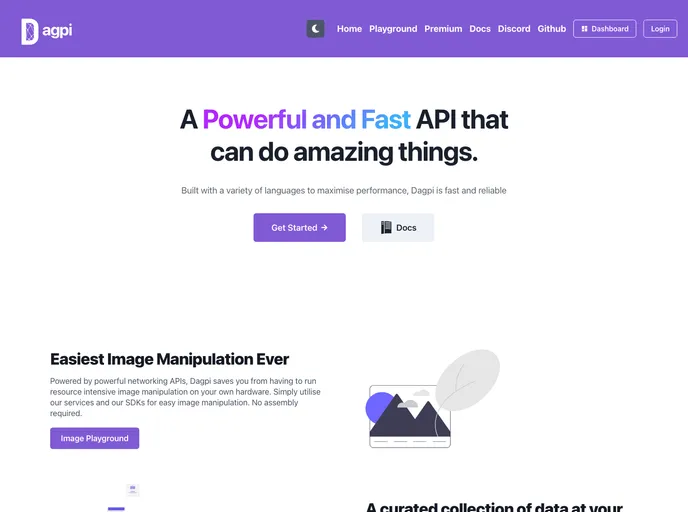




The dashboard for dagpi. Built with nextjs!
Overview:
The Dagpi Dashboard is a web application that provides users with a range of tools and features. It is built using Next.js, NextAuth, and Chakra-UI, and incorporates various other technologies such as Eslint, Prettier, Formik + Yup, Stripe Checkout, PayPal Checkout, Google Analytics, and Sentry. The dashboard can be tested locally using the command "yarn dev" and deployed on Vercel by running "yarn build" and "yarn start". The development of the dashboard was supported by the Reactiflux Discord community, as well as Dagpi users and staff.
Features:
- Next.js: The dashboard is built using Next.js, a popular React framework for creating server-side rendered applications.
- NextAuth: NextAuth is used for authentication and user management, enabling users to securely log in and access their personalized dashboard.
- Chakra-UI: Chakra-UI is a component library used in the development of the dashboard, providing a set of pre-styled and customizable UI components.
- Eslint: Eslint is used for code linting, helping to ensure code quality and adherence to a consistent coding style.
- Prettier: Prettier is an opinionated code formatter used to automatically format code, enhancing readability and maintainability.
- Formik + Yup: Formik is a form library that simplifies form management, while Yup is used for form validation, ensuring the input data is correct.
- Stripe Checkout: Stripe Checkout integration enables the dashboard to handle secure payments through the Stripe payment gateway.
- PayPal Checkout: PayPal Checkout integration allows users to make payments using their PayPal accounts, providing an alternative payment method.
- Google Analytics: Google Analytics integration enables tracking and analysis of user behavior and website performance.
- Sentry: Sentry is used for error tracking and monitoring, helping to identify and resolve any issues that may arise.
Summary:
The Dagpi Dashboard is a feature-rich web application built using Next.js and incorporating various other technologies. It provides users with authentication, payment processing, form management, and analytics capabilities. The development process was supported by the Reactiflux Discord community and received feedback and contributions from Dagpi users and staff. By following the installation and deployment instructions, users can set up their own instances of the Dagpi Dashboard for testing or production use.
- Next.js
Next.js is a React-based web framework that enables server-side rendering, static site generation, and other powerful features for building modern web applications.
- React
React is a widely used JavaScript library for building user interfaces and single-page applications. It follows a component-based architecture and uses a virtual DOM to efficiently update and render UI components
- SCSS
SCSS is a preprocessor scripting language that extends the capabilities of CSS by adding features such as variables, nesting, and mixins. It allows developers to write more efficient and maintainable CSS code, and helps to streamline the development process by reducing repetition and increasing reusability.
- Chakra UI
Chakra UI is a popular open-source React component library that provides a set of accessible and customizable UI components to help developers create modern web applications.
- Dashboard

A dashboard style website template is a pre-designed layout that features a user interface resembling a control panel or dashboard. It typically includes charts, graphs, tables, and other data visualization tools that allow users to monitor and analyze data in real-time.
- Eslint

ESLint is a linter for JavaScript that analyzes code to detect and report on potential problems and errors, as well as enforce consistent code style and best practices, helping developers to write cleaner, more maintainable code.
- Framer Motion

Alpine.js is a lightweight JavaScript framework that simplifies the process of creating dynamic, reactive user interfaces on the web. It uses a declarative syntax that offers a higher level of abstraction compared to vanilla JavaScript, while being more performant and easier to use than jQuery.
- Typescript

TypeScript is a superset of JavaScript, providing optional static typing, classes, interfaces, and other features that help developers write more maintainable and scalable code. TypeScript's static typing system can catch errors at compile-time, making it easier to build and maintain large applications.
- Webpack

Webpack is a popular open-source module bundler for JavaScript applications that bundles and optimizes the code and its dependencies for production-ready deployment. It can also be used to transform other types of assets such as CSS, images, and fonts.
- Formik

Formik is a popular form library for React that helps with form state management, validation, and submission handling. It provides a declarative approach to building forms with support for complex validation scenarios and easy integration with validation libraries like Yup.
- Yup
Yup is a schema builder for runtime value parsing and validation. It provides a declarative way to define validation schemas with support for complex nested objects, array validation, and custom validation rules. Often used with Formik for form validation.