
Angular 8 Registration Login Example
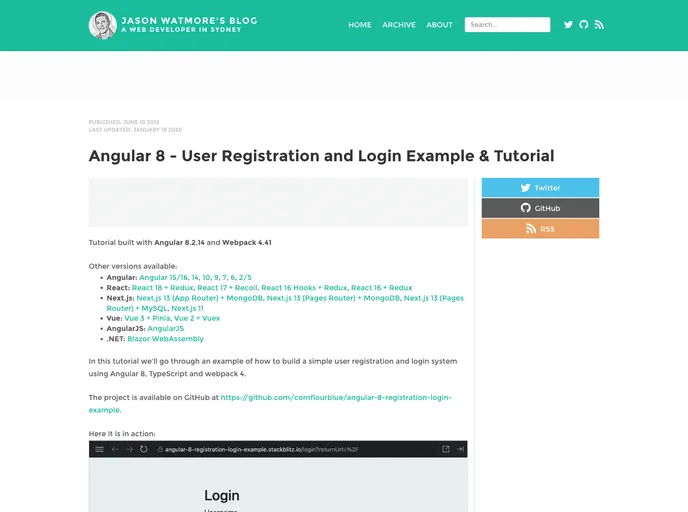


Angular 8 User Registration and Login Example
Overview
The angular-8-registration-login-example is a user registration and login example built on Angular 8 and Webpack 4. It provides a tutorial and example code to demonstrate the implementation of user registration and login features in an Angular application. The tutorial is available at https://jasonwatmore.com/post/2019/06/10/angular-8-user-registration-and-login-example-tutorial.
Features
- User registration functionality
- User login functionality
- Form validation for input fields
- Responsive layout for different screen sizes
Summary
The angular-8-registration-login-example is a helpful resource for developers looking to implement user registration and login features in their Angular 8 projects. The tutorial provides a step-by-step guide and example code for better understanding. With features like user registration, login, form validation, and responsive layout, it serves as a great starting point for building secure authentication functionality in Angular applications.
- Angular
Angular is a TypeScript-based open-source framework by Google for building dynamic single-page applications and cross-platform mobile apps with MVC architecture and a rich set of features.
- LESS
Less CSS is a dynamic stylesheet language that extends the capabilities of CSS, allowing developers to write cleaner, more modular, and reusable stylesheets with features like variables, mixins, and nested rules.
- Typescript

TypeScript is a superset of JavaScript, providing optional static typing, classes, interfaces, and other features that help developers write more maintainable and scalable code. TypeScript's static typing system can catch errors at compile-time, making it easier to build and maintain large applications.
- Webpack

Webpack is a popular open-source module bundler for JavaScript applications that bundles and optimizes the code and its dependencies for production-ready deployment. It can also be used to transform other types of assets such as CSS, images, and fonts.