
Django React Postgres
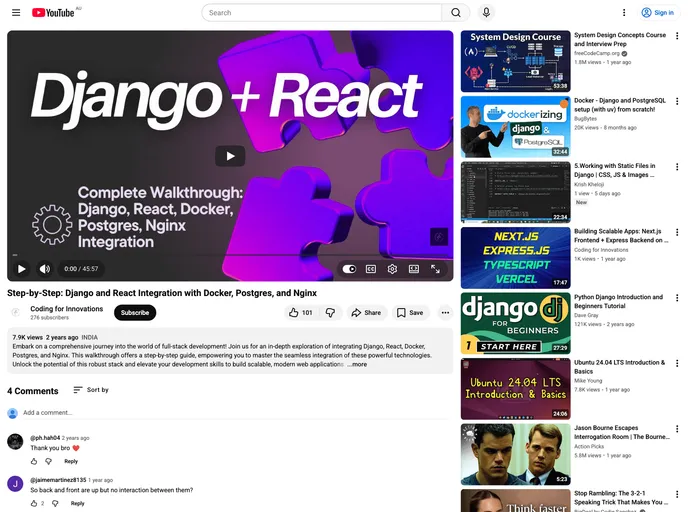


A Bootstrapped Template of Django with React using Docker, Postgres Database and Nginx!
Overview
Django React Postgres is a powerful bootstrapped template that combines the strengths of Django and React to create a robust web application framework. This template is designed for developers who want to leverage the fluidity of React on the frontend while utilizing Django for backend capabilities. By employing Docker, it ensures convenience and consistency in deployment, making it an excellent choice for building scalable applications.
The inclusion of a Postgres database provides a reliable storage solution, while Nginx serves as an efficient web server that can handle incoming requests effectively. With this template, developers can jumpstart their projects and focus on building features without worrying about the basic setup.
Features
- Django Backend: Utilizes Django’s powerful framework for creating robust REST APIs and handling server-side logic.
- React Frontend: Takes advantage of React’s component-based architecture for building dynamic and responsive user interfaces.
- Docker Support: Simplifies the development and deployment process by containing all dependencies within Docker containers.
- Postgres Database: Offers a reliable and powerful relational database for data storage, ensuring high performance and scalability.
- Nginx Web Server: Enhances the application’s efficiency by serving static files and managing requests seamlessly.
- Easy Setup: Provides a pre-configured environment, allowing developers to quickly get started without extensive initial setup.
- Cross-Platform Compatibility: Works on various operating systems, making it accessible for developers using different platforms.
- Django
Django is a high-level Python web framework that encourages rapid development and clean, pragmatic design. It follows the model-view-controller (MVC) architectural pattern, providing an extensive set of built-in tools and conventions to streamline the creation of robust and scalable web applications.
- React
React is a widely used JavaScript library for building user interfaces and single-page applications. It follows a component-based architecture and uses a virtual DOM to efficiently update and render UI components
- Fullstack

A fullstack boilerplate provides a starter application that includes both frontend and backend. It should include database, auth, payments, user roles and other backend services to build a fully featured saas or webapps.
- Docker

A website that uses Docker for containerization to streamline development, testing, and deployment workflows. This includes features such as containerization of dependencies, automated builds and deployments, and container orchestration to ensure scalability and availability.
- Typescript

TypeScript is a superset of JavaScript, providing optional static typing, classes, interfaces, and other features that help developers write more maintainable and scalable code. TypeScript's static typing system can catch errors at compile-time, making it easier to build and maintain large applications.