
Mage Website
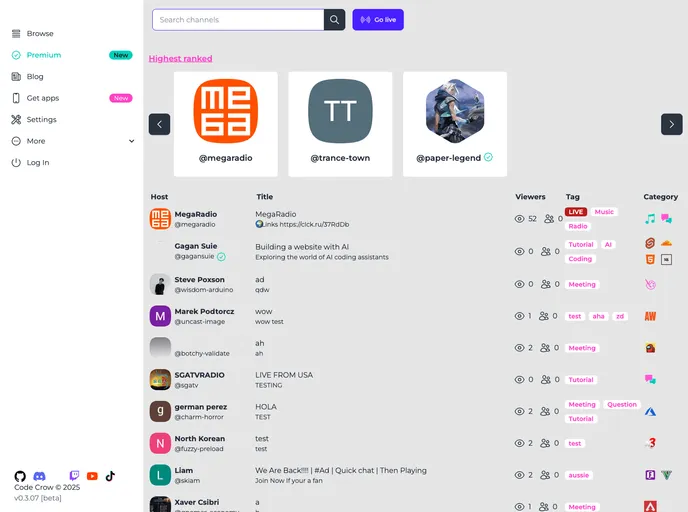




A re/streaming platform
Overview:
The content is related to the development of a project and how to contribute to it. It mentions the process of forking and cloning the project, as well as the use of the issue tracker and making pull requests (PR). It also emphasizes the importance of providing feedback and making feature requests.
Features:
- Fork and Clone: The project provides instructions on how to fork and clone the repository to start development.
- Issue Tracker: There is an issue tracker provided for discussions regarding potential implementations or feature requests.
- Pull Requests: The process of making a pull request is mentioned, where it is recommended to open an issue beforehand to discuss the proposed change.
- Feedback and Appreciation: The content encourages users to provide feedback, which is welcome and appreciated by the project team.
Summary:
The content provides an overview of the development process for a particular project. It highlights the steps of forking and cloning the project, using the issue tracker for discussions, and making pull requests. The emphasis is on actively engaging with the project and providing feedback for potential improvements.
- Svelte
Svelte is a modern front-end framework that compiles your code at build time, resulting in smaller and faster applications. It uses a reactive approach to update the DOM, allowing for high performance and a smoother user experience.
- Vite
Vite is a build tool that aims to provide a faster and leaner development experience for modern web projects
- Tailwind
Tailwind CSS is a utility-first CSS framework that provides pre-defined classes for building responsive and customizable user interfaces.
- daisyUI
daisyUI adds classes to Tailwind CSS for all common UI components. Classes like btn, card, etc. This allows us to focus on important things instead of making basic elements for every project.
- Eslint

ESLint is a linter for JavaScript that analyzes code to detect and report on potential problems and errors, as well as enforce consistent code style and best practices, helping developers to write cleaner, more maintainable code.
- Postcss

PostCSS is a popular open-source tool that enables web developers to transform CSS styles with JavaScript plugins. It allows for efficient processing of CSS styles, from applying vendor prefixes to improving browser compatibility, ultimately resulting in cleaner, faster, and more maintainable code.
- Typescript

TypeScript is a superset of JavaScript, providing optional static typing, classes, interfaces, and other features that help developers write more maintainable and scalable code. TypeScript's static typing system can catch errors at compile-time, making it easier to build and maintain large applications.