
React Openapi Designer
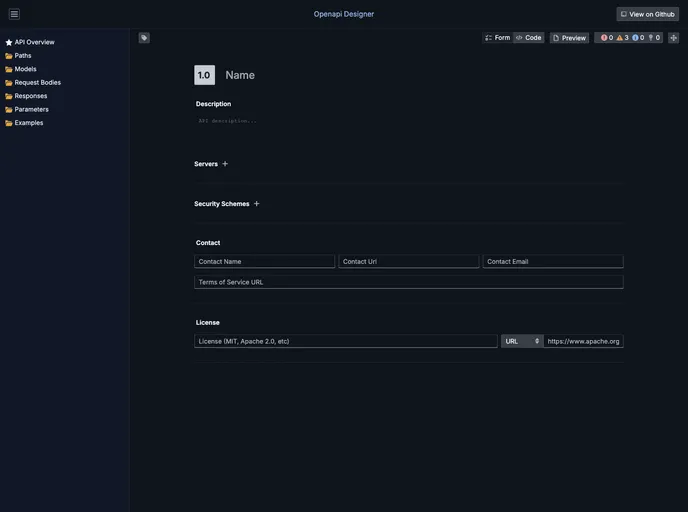




A React based UI toolkit to develop openapi schema
Overview
React OpenAPI Designer is an innovative tool specifically designed for creating and managing OpenAPI specifications using a React-based interface. This application allows users to construct new API specifications from the ground up or seamlessly import existing YAML files, making it a versatile option for developers looking to work with OpenAPI standards. With its user-friendly UI, it streamlines the process of API design, ensuring both efficiency and adherence to modern API practices.
This tool not only simplifies API design but also supports collaboration and testing through various features, making it an essential asset for developers. Whether you are a seasoned API designer or a novice, React OpenAPI Designer offers a robust set of functionalities that cater to different needs within the API development lifecycle.
Features
-
Live Preview: Instantly see changes as you create or edit OpenAPI specifications, allowing for real-time feedback and adjustments.
-
Import Existing YAML: Easily paste your existing OpenAPI YAML files to modify them within the intuitive UI, saving time and effort.
-
Static Website Hosting: After building your project, you can host it as a static website by uploading compiled files from the dist/ directory.
-
Spec Change Listeners: Monitor changes made to the OpenAPI specification and trigger actions based on those changes, enhancing workflow automation.
-
Mock URL Handling: Add external URLs for host mocking which will display as a mock URL in the Samples widget, making it easier to test different scenarios.
-
Local Development Setup: Get started with local development by cloning the repository, installing npm modules, and launching the development server, bringing the power of React to your projects.
- React
React is a widely used JavaScript library for building user interfaces and single-page applications. It follows a component-based architecture and uses a virtual DOM to efficiently update and render UI components
- SCSS
SCSS is a preprocessor scripting language that extends the capabilities of CSS by adding features such as variables, nesting, and mixins. It allows developers to write more efficient and maintainable CSS code, and helps to streamline the development process by reducing repetition and increasing reusability.
- Styled Components
Styled Components is a popular library for styling React components using CSS syntax. It allows you to write CSS in your JavaScript code, making it easier to create dynamic styles that are specific to each component.
- Tailwind
Tailwind CSS is a utility-first CSS framework that provides pre-defined classes for building responsive and customizable user interfaces.
- Eslint

ESLint is a linter for JavaScript that analyzes code to detect and report on potential problems and errors, as well as enforce consistent code style and best practices, helping developers to write cleaner, more maintainable code.
- GitHub Pages

Gridsome is a Vue.js-based static site generator that makes it easy to build fast and flexible websites and applications by leveraging modern web technologies like GraphQL, Webpack, and hot reloading
- Mobx

MobX is a simple and scalable state management library for JavaScript applications. It uses reactive programming techniques to automatically update the user interface in response to changes in the application state, making it easy to build complex and dynamic user interfaces with minimal code.
- Postcss

PostCSS is a popular open-source tool that enables web developers to transform CSS styles with JavaScript plugins. It allows for efficient processing of CSS styles, from applying vendor prefixes to improving browser compatibility, ultimately resulting in cleaner, faster, and more maintainable code.
- Redux
Redux is a state management library for JavaScript apps that provides a predictable and centralized way to manage application state. It enables developers to write actions and reducers that update the state in response to user interactions, server responses, and other events, and can be used with a variety of front-end frameworks and back-end technologies.
- Webpack

Webpack is a popular open-source module bundler for JavaScript applications that bundles and optimizes the code and its dependencies for production-ready deployment. It can also be used to transform other types of assets such as CSS, images, and fonts.