
Lomer UI
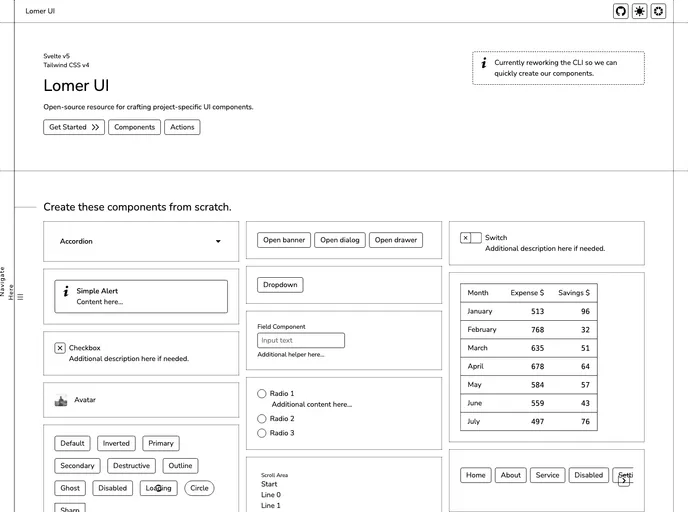



Open-source resource for crafting project-specific UI components using Svelte & Tailwind CSS.
Overview
Lomer UI is an innovative open-source resource designed for developers looking to create custom user interfaces using Svelte and Tailwind CSS. Unlike traditional component libraries, Lomer UI serves as a flexible foundation for building unique project-specific components. This approach offers developers the freedom to craft their UIs with a focus on simplicity, accessibility, and clarity, all while avoiding the drawbacks of generic design systems.
What sets Lomer UI apart is its emphasis on providing complete control over the design process. This tool is perfect for those who want to avoid the bloat of standard UI kits and prefer a lightweight, maintainable codebase that can scale with their projects.
Features
- Built with Svelte — Leverages the power of reactive programming for fast and enjoyable development.
- Styled with Tailwind CSS — Utilizes a utility-first approach, promoting customization and flexibility in design.
- Focus on Reusability — Aims to create reusable, project-specific components without imposing an opinionated design system.
- Clean Structure — Offers a minimal setup that streamlines fast prototyping and scaling for various projects.
- Learning Opportunity — Ideal for developers wanting to learn by building UI from the ground up rather than relying on pre-packaged solutions.
- Avoids Over-Engineering — Designed for those who wish to sidestep the complexities often found in more cumbersome libraries.
- Lightweight Codebase — Encourages a maintainable and efficient coding environment, reducing the risk of unnecessary bloat.
- Svelte
Svelte is a modern front-end framework that compiles your code at build time, resulting in smaller and faster applications. It uses a reactive approach to update the DOM, allowing for high performance and a smoother user experience.
- Vite
Vite is a build tool that aims to provide a faster and leaner development experience for modern web projects
- Tailwind
Tailwind CSS is a utility-first CSS framework that provides pre-defined classes for building responsive and customizable user interfaces.
- UI Kits & Components

A UI kit provides developers with a set of reusable components that can be easily integrated into a website or application. These components are pre-designed with consistent styling and functionality, allowing developers to save time and effort in the design and development process. UI kits can be either custom-built or third-party, and often include components for buttons, forms, typography, icons, and more.
- Postcss
PostCSS is a popular open-source tool that enables web developers to transform CSS styles with JavaScript plugins. It allows for efficient processing of CSS styles, from applying vendor prefixes to improving browser compatibility, ultimately resulting in cleaner, faster, and more maintainable code.
- Typescript

TypeScript is a superset of JavaScript, providing optional static typing, classes, interfaces, and other features that help developers write more maintainable and scalable code. TypeScript's static typing system can catch errors at compile-time, making it easier to build and maintain large applications.