
FeastQR
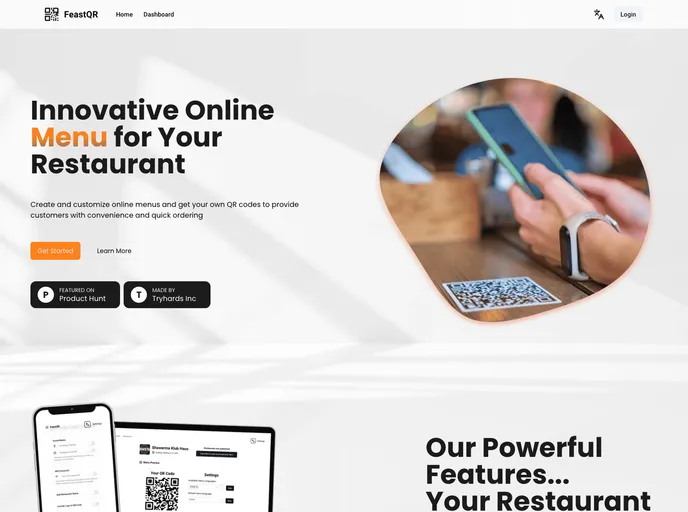



FeastQR: Open Source SaaS Online Menu System
Overview
FeastQR is an innovative open-source SaaS online menu system that caters to the needs of modern restaurants. It streamlines the dining experience by enabling easy menu interaction through QR codes, making ordering seamless for customers. Designed by the talented team at Tryhards Inc., FeastQR is flexible and adaptable, ensuring that restaurant owners can easily manage their offerings and pricing in real-time.
With its robust technology stack and user-friendly interface, FeastQR stands out as a powerful tool for restaurant management. Whether you're looking to modernize your menu presentation or simply enhance the dining experience for your guests, this system provides an effective solution.
Features
- QR Code Generation: Facilitates effortless ordering with unique QR codes tailored to your menu items.
- Real-time Menu and Price Management: Easily update your menu and pricing information as needed, ensuring accuracy and responsiveness.
- Ready to Print PDF Templates: Customize and print your own Menu QR Card for easy distribution and display in your establishment.
- Deployment Support: Edge-ready deployment options with Vercel, making it easy to get your menu online swiftly.
- User-Friendly Technology Stack: Built on Next.js and Supabase, providing a solid backend with secure authentication and storage solutions.
- Stylish UI: With Tailwind CSS and Shadcn UI, the interface is not only functional but visually appealing, enhancing the customer experience.
- Comprehensive Analytics: Integrated with Umami for performance tracking, allowing you to understand customer interactions with your menu.
- Multilingual Support: Utilize i18next for internalization, making it easier to cater to a diverse clientele.
FeastQR redefines how restaurants present their menus and interact with customers, making it a valuable addition to any dining environment.
- Next.js
Next.js is a React-based web framework that enables server-side rendering, static site generation, and other powerful features for building modern web applications.
- React
React is a widely used JavaScript library for building user interfaces and single-page applications. It follows a component-based architecture and uses a virtual DOM to efficiently update and render UI components
- TanStack
TanStack is a collection of high-quality, framework-agnostic libraries including TanStack Query for data fetching, TanStack Router for routing, TanStack Table for tables, and more. These tools provide powerful, type-safe solutions for common web development challenges.
- Tailwind
Tailwind CSS is a utility-first CSS framework that provides pre-defined classes for building responsive and customizable user interfaces.
- Headless UI
Headless UI is a set of completely unstyled, fully accessible UI components for React, Vue, and Alpine.js that empower developers to build their own fully accessible custom UI components. Headless UI allows developers to focus on building accessible and highly functional user interfaces, without the need to worry about styling or layout.
- Prisma
Prisma is a server-side library that helps developers read and write data to the database in an intuitive, efficient and safe way.
- Fullstack

A fullstack boilerplate provides a starter application that includes both frontend and backend. It should include database, auth, payments, user roles and other backend services to build a fully featured saas or webapps.
- Eslint

ESLint is a linter for JavaScript that analyzes code to detect and report on potential problems and errors, as well as enforce consistent code style and best practices, helping developers to write cleaner, more maintainable code.
- Postcss

PostCSS is a popular open-source tool that enables web developers to transform CSS styles with JavaScript plugins. It allows for efficient processing of CSS styles, from applying vendor prefixes to improving browser compatibility, ultimately resulting in cleaner, faster, and more maintainable code.
- Typescript

TypeScript is a superset of JavaScript, providing optional static typing, classes, interfaces, and other features that help developers write more maintainable and scalable code. TypeScript's static typing system can catch errors at compile-time, making it easier to build and maintain large applications.
- React Hook Form

React Hook Form is a performant, flexible, and extensible form library for React with easy validation. It reduces re-renders and improves performance by using uncontrolled components and native HTML validation, making form handling simple and efficient.
- Zod

Zod is a TypeScript-first schema declaration and validation library. It allows you to define schemas that can validate data at runtime while providing excellent TypeScript inference, making it perfect for API validation, form validation, and type-safe data handling.